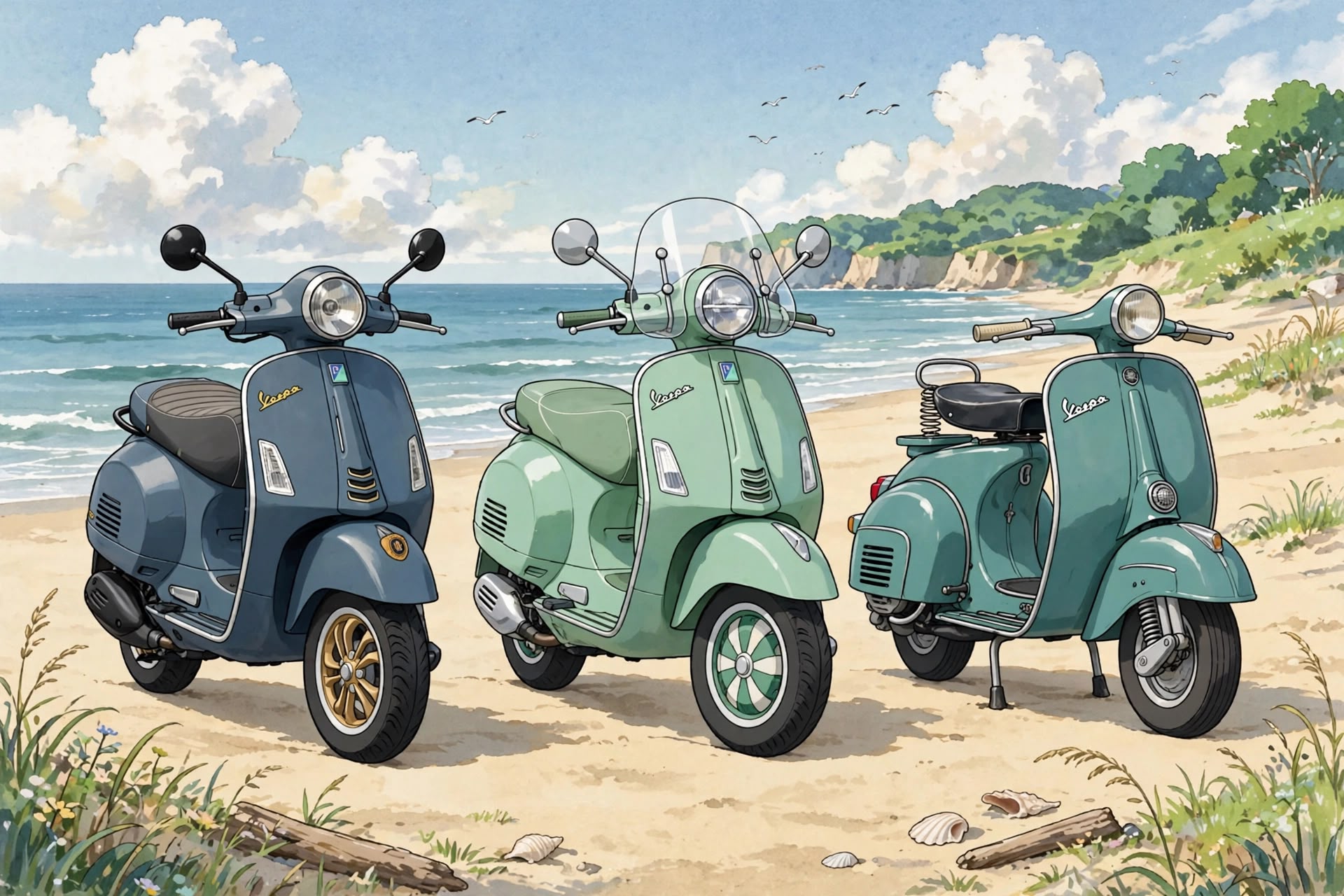
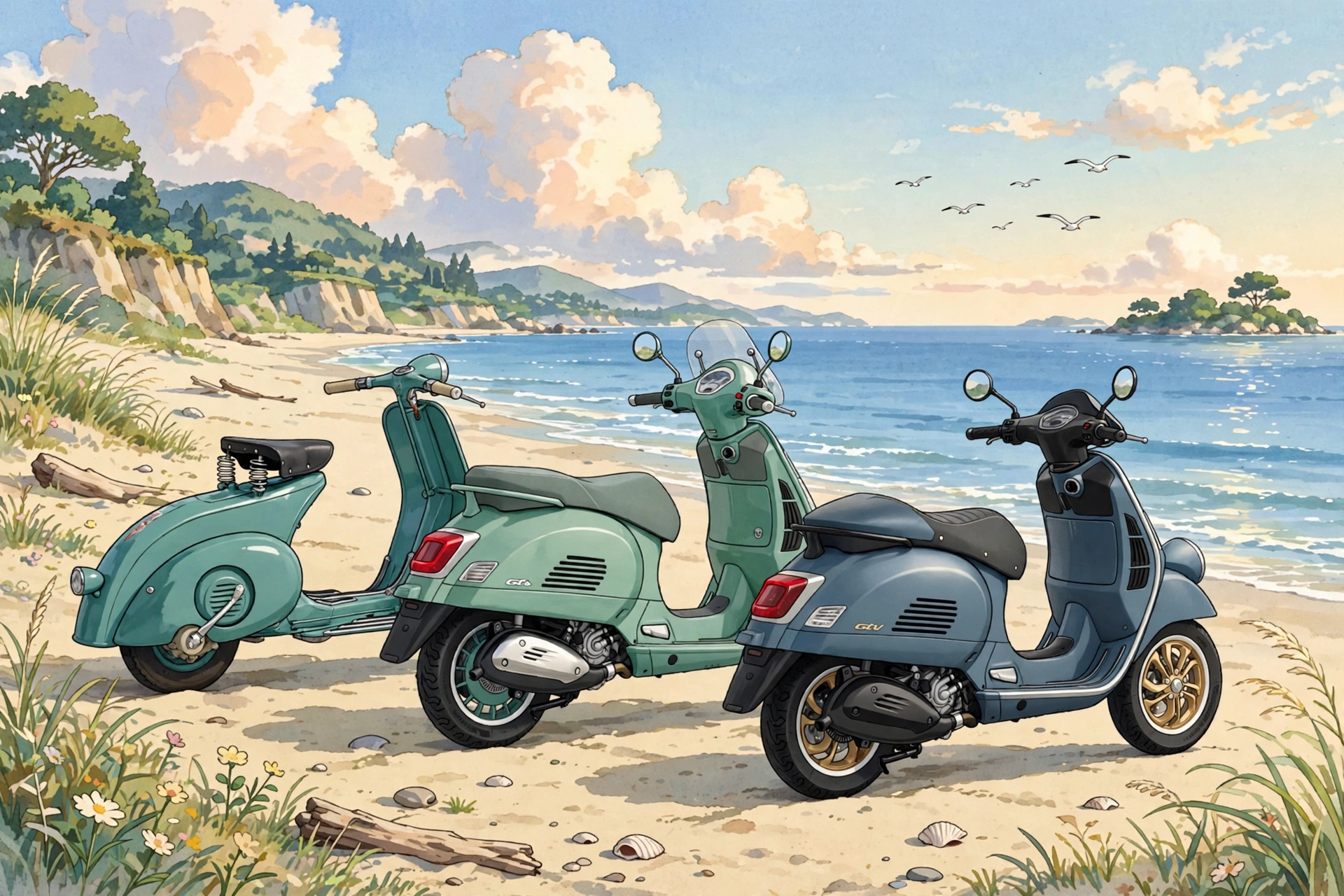
The GTS 80th and GTV Officina 8 celebrate different aspects of Vespa heritage: the former commemorates the brand’s 80th anniversary, while the latter pays tribute to Piaggio’s historic experimental engineering department.
Vespa GTS 80th Limited Edition vs Vespa GTV Officina 8: Celebrating 80 Years of Italian Heritage, Design and Engineering
Introduction
Vespa is one of the world’s most recognisable scooter brands, representing much more than personal transportation. Since its introduction in 1946, the Italian manufacturer has built a reputation for distinctive styling, innovative engineering, cultural influence and timeless design. Over eight decades, Vespa has evolved from a practical post-war mobility solution into an international lifestyle icon.
To celebrate its 80th anniversary, Vespa has introduced special-edition models that reconnect its modern scooters with the company’s remarkable history. Two particularly interesting examples are the Vespa GTS 80th Limited Edition and the Vespa GTV Officina 8.
Although both scooters are based on Vespa’s large-frame platform and share the brand’s traditional steel-body construction, they tell different stories.
The GTS 80th Limited Edition celebrates eight decades of Vespa history. Its exclusive Verde Pastello colour, anniversary badges and retro-inspired wheels recall the appearance of the earliest Vespa scooters while incorporating modern engineering and technology.
The GTV Officina 8, meanwhile, pays tribute to the experimental department at Piaggio’s Pontedera factory. Known as Officina 8, this historic workshop played an important role in developing early Vespa prototypes, racing machines and engineering innovations. Its distinctive industrial blue paintwork, brass-coloured details and special identification plate recreate elements of this engineering heritage.
Both models offer something beyond the standard Vespa ownership experience. They combine familiar large-frame scooter performance with distinctive styling, exclusive equipment and limited production numbers.
For collectors, long-time Vespa enthusiasts and riders who appreciate Italian design, these two editions offer an opportunity to own a scooter with a particularly meaningful connection to the brand’s history.
This article examines their heritage, styling, technical specifications, performance, comfort, technology, ownership costs and pricing in Thailand. It also compares their advantages and disadvantages to help prospective buyers decide which limited-edition Vespa deserves a place in their garage.
1. Vespa’s 80-Year Heritage and Italian History
The birth of Vespa in 1946
Vespa was born in Italy during the difficult period following the Second World War.
The Piaggio company, originally established by Rinaldo Piaggio in 1884, had developed considerable experience in industrial manufacturing, shipbuilding and aircraft production. However, the destruction caused by the war created the need to rebuild its factories and identify new opportunities.
Enrico Piaggio recognised that Italy needed affordable, practical transportation. Many people required an inexpensive vehicle that could provide personal mobility without the complexity and cost associated with conventional motorcycles.
He commissioned aeronautical engineer Corradino D’Ascanio to develop a new type of two-wheeled vehicle.
D’Ascanio approached the project from an unconventional engineering perspective. Rather than simply creating another motorcycle, he designed a scooter with a step-through frame, enclosed mechanical components, a comfortable riding position and practical controls.
The resulting vehicle became the Vespa 98.
On 23 April 1946, Piaggio filed the patent for its revolutionary scooter design, marking the beginning of one of the most successful names in the history of motorised transportation.
The name Vespa, meaning wasp in Italian, reportedly came from Enrico Piaggio’s reaction to the appearance and sound of the original scooter.
From practical transportation to an international icon
During the late 1940s and 1950s, Vespa became an important part of Italy’s post-war recovery.
Its accessible price, practical design and relatively straightforward operation made it attractive to a broad range of customers. The scooter also helped transform personal mobility by making independent transportation more accessible.
Vespa subsequently expanded into international markets, developing a strong following throughout Europe and beyond.
Its cultural influence grew significantly after the appearance of the scooter in the 1953 Hollywood film Roman Holiday, starring Audrey Hepburn and Gregory Peck.
The film helped establish Vespa as a symbol of Italian romance, freedom and fashionable urban living.
Over the following decades, Vespa became closely associated with:
- Italian industrial design and craftsmanship.
- European urban culture and lifestyle.
- Personal freedom and independent mobility.
- Classic scooter engineering.
- Fashion, cinema, music and popular culture.
- Motorcycle touring and enthusiast communities.
Eight decades of continuous evolution
Vespa has introduced numerous generations and model families since 1946.
Some important milestones include:
| Period | Historical development |
|---|---|
| 1946 | Original Vespa 98 introduced |
| 1948 | Vespa 125 introduced |
| 1950s | International expansion and growing cultural popularity |
| 1955 | Vespa GS introduces a more sporting direction |
| 1960s | Development of smaller-capacity and lifestyle models |
| 1970s–1980s | Continued evolution of the classic Vespa range |
| 1990s | Introduction of more modern automatic scooter designs |
| 2000s | Modern large-frame scooters become increasingly important |
| 2010s | Growth of electronically fuel-injected and technologically advanced models |
| 2020s | Continued development of premium scooters and special editions |
| 2026 | Vespa celebrates its 80th anniversary |
By 2026, Vespa’s history encompasses eight decades of design evolution, manufacturing development and international influence.
The GTS 80th Limited Edition is a direct celebration of this milestone, translating the appearance of early Vespa scooters into a contemporary large-frame machine.
2. The History and Significance of Officina 8
What was Officina 8?
Officina 8 was an important experimental department within Piaggio’s historic factory in Pontedera, Italy.
Following the Second World War, the facility became a centre for engineering experimentation, product development and specialised manufacturing.
It brought together highly skilled designers, engineers, mechanics, metalworkers and test riders.
Many of these professionals had backgrounds in the aeronautical industry, bringing valuable knowledge of materials, manufacturing techniques and mechanical engineering to the development of Vespa scooters.
Officina 8 was not simply an ordinary production workshop. It was a place where engineers could develop experimental ideas, construct prototypes and test new technical solutions.
Experimental engineering and racing development
The department contributed to several important developments in Vespa’s history.
Its activities included:
- Designing and constructing experimental scooter prototypes.
- Developing specialised frames and mechanical components.
- Manufacturing custom-built racing machines.
- Testing new engine configurations.
- Developing scooters for endurance and speed records.
- Improving mechanical reliability and production techniques.
Among the notable machines associated with this engineering tradition were the legendary Vespa 98 Corsa and specialised competition scooters.
Vespa also achieved significant sporting milestones during the early 1950s.
In 1950, a specially prepared Vespa established 17 world speed and endurance records. In 1951, the brand achieved a flying-kilometre record.
These achievements helped demonstrate that a scooter originally developed for practical transportation could also become a platform for engineering experimentation and sporting performance.
The original Officina 8 identity
The historical department had its own distinctive identity.
Technicians working in the experimental facility wore special work clothing, identified by a blue and brass-coloured Piaggio 8 badge.
This emblem became a symbol of engineering knowledge, craftsmanship and membership in an exclusive technical department.
The modern GTV Officina 8 uses this historical identity as the foundation of its styling.
Its industrial blue paint, brass-coloured detailing and dedicated identification plate are not arbitrary decorative choices. They reference the materials, working environment and visual identity associated with the original experimental workshop.
This makes the GTV Officina 8 particularly interesting for enthusiasts who appreciate the engineering history behind the Vespa brand.
It celebrates not only the appearance of an old scooter but also the people and technical work that helped establish Vespa’s reputation.
3. Vespa GTS 80th Limited Edition: Anniversary Design and Identity
The Vespa GTS 80th Limited Edition is designed to commemorate the brand’s 80th anniversary.
Rather than introducing an entirely new scooter platform, Vespa has taken its established large-frame GTS design and transformed it through special colours, exclusive detailing and anniversary-specific components.
The result is a scooter that combines modern GTS proportions with visual references to the earliest Vespa generations.
Exclusive Verde Pastello colour
One of the most distinctive characteristics of the GTS 80th is its Verde Pastello finish.
This special pastel green shade, also identified internationally as Verde 80th, takes inspiration from the early single-colour Vespa models.
Its appearance is noticeably different from the metallic and contemporary colours commonly found on modern scooters.
The pastel finish creates a softer, more traditional appearance while retaining the visual presence of a modern large-frame Vespa.
The colour is particularly appropriate for an anniversary model because it connects the contemporary scooter with the brand’s earliest design language.
Anniversary-specific wheels
The GTS 80th features newly designed solid-style alloy wheels inspired by the appearance of classic Vespa wheels.
Their design gives the scooter a more traditional character than the sportier wheel designs found on some standard GTS variants.
The EST. 1946 engraving further reinforces the historical significance of the model.
This small detail is important because it connects the scooter directly to the year Vespa was established.
Exclusive anniversary badges
The GTS 80th includes dedicated anniversary identification.
Important visual elements include:
- Special 80th anniversary identification plate.
- EST. 1946 commemorative detailing.
- Exclusive Verde Pastello body colour.
- Anniversary-specific wheel design.
- Special seat and trim details.
- Classic-inspired exterior finishes.
Together, these components distinguish the anniversary edition from an ordinary GTS.
Classic design with modern proportions
The GTS platform has a recognisable large-frame silhouette.
Its broad front shield, sculpted side panels and traditional steel bodywork give it a substantial appearance.
The GTS 80th retains this familiar design while using its exclusive colour and detailing to create a more heritage-oriented character.
It is particularly attractive to riders who appreciate the traditional appearance of older Vespa models but prefer the performance and convenience of a modern automatic scooter.
4. Vespa GTV Officina 8: Industrial Heritage and Sporting Character
The Vespa GTV Officina 8 approaches special-edition design from a different direction.
Instead of celebrating the entire Vespa brand, it concentrates on a specific chapter of Piaggio’s engineering history.
Its styling is inspired by the experimental department that helped develop early Vespa prototypes and competition machines.
Blu Officina 8 paintwork
The most immediately recognisable feature is its exclusive Blu Officina 8 finish.
This industrial-inspired blue has a distinctive appearance, recalling the colour of machinery, metalworking equipment and work clothing associated with historic engineering workshops.
The finish gives the GTV a more industrial and technical personality than the traditional pastel green of the GTS 80th.
It also creates a striking contrast with the scooter’s brass-coloured components.
Brass-coloured detailing
The GTV Officina 8 uses brass-inspired finishing across several components.
These include:
- Brass-coloured wheel details.
- Decorative seat rivets.
- Special Officina 8 identification plate.
- Selected metallic trim components.
- Contrasting finishing details.
The brass elements give the scooter a handcrafted appearance.
They also reference the original blue-and-brass badge worn by members of Piaggio’s experimental department.
Exclusive seat design
The seat is another important element of the Officina 8 edition.
It features a black upholstered finish, horizontal stitching and contrasting decorative details.
The brass-coloured rivets provide a visual connection to the historical Officina 8 identity.
This combination creates a more industrial and sporting appearance than the traditional seat designs found on many standard Vespa models.
Exposed handlebar and low-mounted headlight
The GTV is one of the most visually distinctive models in the modern Vespa range.
Its low-mounted headlight and exposed handlebar arrangement recall the design language of earlier sporting Vespa models.
This arrangement gives the scooter a different front-end appearance from the more conventional GTS.
The Officina 8 edition further enhances this identity through its matte-black bar-end mirrors and additional dark finishing details.
Sport-inspired rear styling
The GTV Officina 8 also features a colour-matched rigid seat cover.
This component references the fairings used on historical Vespa competition machines.
When fitted, it gives the scooter a more sporting silhouette and reinforces its connection with Vespa’s racing heritage.
The result is a scooter that looks different from the conventional urban-focused GTS models.
It has a stronger enthusiast and collector appeal, particularly for riders who appreciate the historical connection between Vespa engineering and competition development.
5. GTS 80th vs GTV Officina 8: Exterior Design Comparison
Although both scooters belong to Vespa’s large-frame family, their design philosophies are noticeably different.
The GTS 80th is a celebration of traditional Vespa styling. Its pastel green colour, anniversary badges and classic-inspired wheels create a nostalgic appearance.
The GTV Officina 8 is more expressive and sporting. Its industrial blue finish, brass-coloured detailing, exposed handlebar and low-mounted headlight create a distinctive mechanical personality.
Design comparison
| Design feature | GTS 80th Limited Edition | GTV Officina 8 |
|---|---|---|
| Main colour | Verde Pastello | Blu Officina 8 |
| Design inspiration | Vespa’s 80-year heritage | Historic Piaggio experimental department |
| Exterior character | Classic and elegant | Industrial and sporting |
| Wheels | Classic-inspired anniversary design | Brass-accented alloy design |
| Seat | Anniversary-specific finish | Black seat with decorative stitching and rivets |
| Special identification | 80th anniversary plate and EST. 1946 | Officina 8 identification plate |
| Headlight | Conventional GTS front design | Low-mounted GTV headlight |
| Handlebar | Conventional GTS arrangement | Exposed handlebar |
| Mirrors | Conventional mirror arrangement | Matte-black bar-end mirrors |
| Rear styling | Traditional GTS appearance | Sporting seat-cover treatment |
Which design is more attractive?
The answer depends largely on personal taste.
The GTS 80th is the more understated choice. Its pastel colour and classic-inspired components make it particularly attractive to riders who appreciate the original Vespa design philosophy.
The GTV Officina 8 is more visually dramatic. The combination of industrial blue and brass details creates a distinctive appearance that is difficult to confuse with an ordinary scooter.
For collectors, the GTV’s historical engineering theme may be particularly appealing. For riders who want a timeless anniversary scooter, the GTS 80th has a more direct connection to the overall Vespa identity.
6. Engine Specifications and Technical Details
Both models belong to Vespa’s large-frame scooter family and use modern four-stroke, liquid-cooled engines with electronic fuel injection and automatic CVT transmissions.
However, buyers should distinguish the actual Thai-market specifications from specifications published for other international markets.
The GTV Officina 8 Thailand brochure identifies its engine as the 278 cc HPE unit. The GTS 80th is based on the Thai-market GTS 300 HPE platform. International GTS 80th specifications can differ, including markets where the newer 310 cc engine is offered.
Vespa GTS 80th Limited Edition
The GTS 80th uses the GTS large-frame platform with its modern HPE engine configuration.
Its engine is designed to provide a balance between acceleration, cruising performance and everyday usability.
The GTS 300 HPE platform is characterised by:
- Single-cylinder, four-stroke engine.
- Four-valve cylinder head.
- Electronic fuel injection.
- Liquid cooling.
- Automatic CVT transmission.
- Automatic centrifugal clutch.
- Large-frame steel body construction.
The HPE engine family is designed to provide responsive acceleration and smooth power delivery without requiring manual gear changes.
Vespa GTV Officina 8
The Thailand-market GTV Officina 8 is equipped with a 278 cc HPE single-cylinder engine.
It uses a four-stroke, four-valve configuration with electronic fuel injection and liquid cooling.
Its official technical specifications include:
| Specification | GTV Officina 8 |
|---|---|
| Engine type | HPE single-cylinder, four-stroke |
| Valve configuration | Four valves |
| Displacement | 278 cc |
| Bore x stroke | 75 x 63 mm |
| Maximum power | 17.5 kW at 8,250 rpm |
| Maximum torque | 26 Nm at 5,250 rpm |
| Fuel system | Electronic fuel injection |
| Cooling | Liquid-cooled |
| Transmission | Automatic CVT |
| Clutch | Automatic dry centrifugal clutch |
| Starting system | Electric |
These specifications place the GTV Officina 8 firmly in the premium mid-to-large-capacity scooter category.
Understanding the HPE engine
HPE stands for High Performance Engine.
Piaggio developed this engine family to deliver improved performance, efficiency and everyday rideability.
Its four-valve cylinder head supports efficient intake and exhaust gas flow, while electronic fuel injection manages fuel delivery according to engine operating conditions.
Liquid cooling helps maintain more consistent operating temperatures, particularly during prolonged riding in heavy traffic or under demanding conditions.
The automatic CVT transmission makes the scooter straightforward to operate.
There is no manual clutch lever or conventional gear selector. The rider simply operates the throttle and brakes.
This makes both scooters suitable for urban commuting as well as longer leisure journeys.
7. Engine Performance and Riding Characteristics
A premium Vespa should deliver more than attractive styling. It should also provide a satisfying riding experience.
Both the GTS and GTV platforms are designed to combine practical scooter convenience with the performance expected from a large-frame machine.
Acceleration and urban performance
The HPE engine provides responsive acceleration from a standstill.
Its automatic transmission allows the rider to concentrate on traffic conditions rather than gear selection.
This is particularly useful in Bangkok and other Thai cities, where traffic conditions can change rapidly.
The GTS platform offers a familiar and versatile riding character.
It is designed to provide smooth acceleration, predictable throttle response and comfortable operation in everyday traffic.
The GTV shares the same general HPE engine philosophy, although its sporting appearance creates a different riding impression.
Highway cruising
Both scooters are suitable for longer journeys when maintained correctly and operated within legal speed limits.
Their larger engines provide more performance potential than typical 125 cc and 150 cc urban scooters.
The additional displacement is useful when accelerating onto faster roads, overtaking slower traffic and maintaining cruising speeds.
However, neither should be confused with a dedicated touring motorcycle.
Their scooter architecture, automatic transmission and relatively compact wheels make them better suited to paved-road touring than aggressive high-speed riding.
CVT transmission advantages
The CVT transmission provides several advantages:
- Simple operation.
- No manual gear changes.
- Smooth acceleration.
- Convenient stop-and-go riding.
- Reduced rider workload in congested traffic.
However, CVT systems require periodic inspection and maintenance.
The drive belt, rollers and clutch components are wear items that should be replaced according to the manufacturer’s service schedule.
Which feels sportier?
The GTV has the more sporting visual identity.
Its exposed handlebar, low-mounted headlight and traditional GTV proportions create the impression of a more enthusiast-oriented scooter.
The GTS has a more conventional large-scooter character.
In practical terms, their underlying engine and transmission concepts are closely related. Buyers should not assume that the Officina 8 edition is mechanically faster simply because it looks sportier.
Their principal differences are styling, equipment and historical identity rather than a fundamentally different performance philosophy.
8. Chassis, Suspension, Brakes and ABS Safety Systems
Vespa’s large-frame scooters are known for their pressed-steel monocoque-style body construction.
Unlike many conventional scooters that use a separate tubular frame with extensive plastic body panels, Vespa integrates much of its structural identity into its steel body.
This contributes to the characteristic feel and appearance of its large-frame models.
Steel-body construction
Both models use a steel load-bearing structure with welded reinforcements.
This construction provides a solid platform for the engine, suspension and bodywork.
It also contributes to Vespa’s distinctive design identity.
However, steel bodywork requires appropriate care in tropical climates. Scratches, damaged paint and exposed metal should be repaired promptly to reduce the possibility of corrosion.
Front suspension
Both scooters use Vespa’s characteristic single-sided front suspension arrangement.
The system uses a coil spring and hydraulic damping.
This design is one of the most recognisable engineering features of the Vespa brand.
It differs from the conventional telescopic front fork commonly found on motorcycles.
Rear suspension
The rear suspension uses twin hydraulic shock absorbers.
The preload can be adjusted to four positions.
This allows the suspension to be adapted to different load conditions, including solo riding and carrying a passenger.
Correct adjustment is important because suspension performance influences handling, stability and comfort.
Braking system
Both models are equipped with hydraulic disc brakes.
The GTV Officina 8 Thailand technical brochure specifies:
- 220 mm front stainless-steel disc.
- 220 mm rear stainless-steel disc.
- Hydraulic brake operation.
- ABS braking assistance.
- ASR traction control.
The GTS 80th also incorporates disc brakes and ABS/ASR according to the GTS 80th technical specification.
ABS and traction control
Anti-lock Braking System (ABS) helps prevent wheel lock-up during hard braking.
This is particularly useful when riding on wet or slippery roads.
Thailand’s tropical climate makes this technology especially relevant because sudden rainfall can create hazardous road conditions.
ASR stands for Anti-Slip Regulation.
It is an electronic traction-control system designed to reduce rear-wheel slip during acceleration.
These systems provide additional assistance but cannot overcome the limitations of tyre grip, excessive speed or inappropriate riding behaviour.
Riders should still maintain safe following distances and adjust their speed according to road conditions.
9. Technology, Instrumentation and Modern Features
Vespa has progressively incorporated more technology into its premium scooter range.
The two limited editions combine traditional styling with modern convenience, although their equipment packages should not automatically be assumed to be identical.
GTS 80th technology
The international GTS 80th specification includes a comprehensive equipment package.
Key features include:
- Five-inch TFT colour dashboard.
- Vespa MIA smartphone connectivity.
- Bluetooth connection.
- Smartphone-based call and music management.
- Pictogram-based navigation functionality.
- Keyless ignition.
- Remote seat opening.
- Bike Finder.
- USB charging port.
- Full LED lighting.
The five-inch TFT display gives the scooter a more contemporary cockpit experience.
It presents riding information in a clear digital format while providing dedicated anniversary graphics.
Vespa MIA allows the rider to connect a compatible smartphone and manage selected functions through the scooter’s controls.
Navigation functionality is subject to the relevant application, market availability and subscription terms.
GTV Officina 8 technology
The GTV Officina 8 combines its traditional sporting design with modern equipment.
Its key equipment includes:
- LED lighting.
- Digital instrumentation.
- Electronic fuel injection.
- ABS braking.
- ASR traction control.
- USB charging connection.
- Automatic CVT transmission.
Vespa’s international GTV Officina 8 documentation identifies Vespa MIA as an optional accessory rather than standard equipment.
Buyers should therefore check the Thai-market specification and included accessories before assuming that smartphone connectivity is included.
Technology comparison
| Feature | GTS 80th | GTV Officina 8 |
|---|---|---|
| Digital instrumentation | Yes | Yes |
| TFT dashboard | Five-inch international specification | Check local specification |
| Keyless system | Yes, international specification | Check local specification |
| ABS | Yes | Yes |
| ASR traction control | Yes | Yes |
| LED lighting | Yes | Yes |
| USB connection | Yes | Yes |
| Smartphone connectivity | Vespa MIA standard internationally | Optional internationally |
| Special graphics | Anniversary graphics | Officina 8 identity |
The GTS 80th has a particularly strong technology package in its international specification.
However, the exact equipment supplied in Thailand should always be confirmed with the authorised dealer.
10. Riding Comfort, Ergonomics and Everyday Practicality
A scooter may be purchased because of its appearance, but comfort and practicality determine how enjoyable it is to own over several years.
Both models offer the advantages of Vespa’s large-frame platform.
Riding position
The GTS provides a relatively upright riding position.
Its conventional handlebar arrangement and step-through design make it familiar to riders transitioning from smaller automatic scooters.
The GTV has a more distinctive handlebar arrangement.
Its exposed handlebar and low-mounted headlight contribute to its sporting character.
Both models have a nominal seat height of approximately 790 mm in their published technical specifications, although the exact Thailand-market specification should be checked before purchase.
Seat comfort
The GTS 80th uses a specially finished seat designed to complement its anniversary colour scheme.
The GTV Officina 8 features a more decorative seat with contrasting stitching and brass-coloured rivets.
Both are designed for everyday riding, although comfort is subjective and depends on rider height, weight and preferred posture.
For longer journeys, a test ride is recommended.
Urban commuting
Both scooters are practical for urban riding.
Their automatic transmissions make them particularly convenient in stop-and-go traffic.
The step-through design also makes mounting and dismounting easier than on many conventional motorcycles.
However, their large-frame dimensions and weight mean they are not as compact as smaller 125 cc scooters.
Riders should consider parking space, traffic filtering and low-speed manoeuvrability before purchasing.
Passenger accommodation
Both models are designed to accommodate a passenger.
The larger seat and substantial bodywork provide a more substantial platform than smaller Vespa models.
However, carrying a passenger changes suspension loading, braking distances and acceleration characteristics.
Rear suspension preload should be adjusted appropriately.
Storage and luggage
Under-seat storage is useful for carrying smaller personal belongings.
A USB charging connection is also convenient for compatible devices.
For riders who regularly carry luggage, optional accessories such as rear racks and top boxes can improve practicality.
The GTV Officina 8’s sporting appearance may encourage owners to preserve its original configuration, whereas the GTS 80th’s more traditional styling works well with classic touring accessories.
11. Fuel Economy, Maintenance and Ownership Costs
Fuel economy and maintenance are important considerations for anyone purchasing a premium scooter.
Although limited editions offer distinctive styling and collector appeal, their long-term ownership costs remain broadly related to the underlying mechanical platform.
Fuel consumption
The published GTV Officina 8 technical specification lists fuel consumption of approximately 31.2 km/l.
The GTS 80th international technical specification lists approximately 31.25 km/l.
These are manufacturer-published reference figures, not guaranteed real-world results.
Actual fuel consumption depends on:
- Traffic congestion.
- Riding speed.
- Acceleration habits.
- Passenger and luggage weight.
- Tyre pressure.
- Road conditions.
- Maintenance condition.
In Bangkok’s congested traffic, actual consumption may be lower than the published figures.
Fuel tank capacity
The GTV Officina 8 has a published fuel tank capacity of approximately 8.5 litres.
The GTS 80th international specification also lists an 8.5-litre tank.
This capacity provides reasonable range for urban commuting and leisure riding.
Maintenance requirements
Both scooters require regular servicing.
Important maintenance items include:
| Component | Maintenance considerations |
|---|---|
| Engine oil | Replace according to the service schedule |
| Oil filter | Inspect and replace as specified |
| Air filter | Inspect and clean or replace |
| Spark plug | Inspect and replace when required |
| CVT drive belt | Inspect and replace according to schedule |
| CVT rollers | Inspect for wear |
| Clutch assembly | Check operation and wear |
| Coolant | Inspect level and replace as specified |
| Brake fluid | Inspect and replace according to schedule |
| Brake pads | Check thickness and condition |
| Tyres | Monitor pressure and tread wear |
| Battery | Check charging condition and terminals |
| Suspension | Inspect for leaks and deterioration |
Ownership costs in Thailand
The cost of owning either scooter will depend on annual mileage, service requirements, insurance coverage and replacement parts.
Potential expenses include:
- Scheduled servicing.
- Engine oil and filters.
- CVT belt and transmission components.
- Tyres.
- Brake pads and brake fluid.
- Battery replacement.
- Coolant and other consumables.
- Annual registration and compulsory insurance.
- Voluntary motorcycle insurance.
- Parking and fuel.
Genuine Vespa components and authorised servicing may cost more than equivalent maintenance for mass-market Japanese scooters.
However, authorised servicing provides access to technicians familiar with the platform and genuine replacement parts.
For a limited-edition owner, maintaining complete service records and retaining original components is particularly important.
It helps demonstrate the scooter’s maintenance history and originality when selling it in the future.
12. Thailand Pricing, Availability and Limited Production Numbers
Thailand is an important market for Vespa, with an established enthusiast community and a strong interest in premium Italian scooters.
Both models have been introduced through Vespa Thailand with exclusive styling and limited availability.
Vespa GTS 80th Limited Edition
The GTS 80th Limited Edition is listed at:
฿245,900
The Thai-market edition is limited to 100 units.
This makes it a relatively exclusive version of the GTS, particularly for buyers who want a scooter commemorating Vespa’s 80th anniversary.
Its special Verde Pastello colour, anniversary badges and dedicated wheels distinguish it from the standard GTS range.
Vespa GTV Officina 8
The GTV Officina 8 has an official Thailand brochure price of:
฿245,900
The model is limited to 88 units in Thailand.
Its production allocation is even smaller than that of the GTS 80th, making it particularly interesting to collectors.
The Officina 8 package includes distinctive paintwork, brass-coloured details, a special seat and exclusive identification components.
Thailand price comparison
| Model | Thailand retail price | Thailand production allocation |
|---|---|---|
| Vespa GTS 80th Limited Edition | ฿245,900 | 100 units |
| Vespa GTV Officina 8 | ฿245,900 | 88 units |
<caption>Prices are based on published Thailand-market information. Confirm current dealer quotations, remaining inventory and promotional offers before purchase.</caption>
Is the GTV Officina 8 more exclusive?
In terms of the published Thailand production allocation, yes.
The GTV Officina 8 has 88 units compared with 100 units for the GTS 80th.
However, production numbers are only one aspect of collectability.
The significance of the edition, its historical theme, condition, originality and future demand are also important.
The GTS 80th has the advantage of being directly associated with the brand’s 80th anniversary, an important milestone that cannot be repeated in the same form.
The GTV Officina 8 has the advantage of a smaller published Thai allocation and a more specialised engineering-history theme.
Both have compelling reasons for collectors to consider them.
13. Collectability, Exclusivity and Potential Resale Value
Limited-edition Vespa scooters appeal to buyers for several reasons.
They combine the established desirability of the Vespa brand with distinctive design elements and restricted production numbers.
However, not every limited-edition scooter automatically becomes a valuable collector’s item.
Long-term value depends on several factors.
Production numbers
The published Thai allocation is:
- GTS 80th Limited Edition: 100 units.
- GTV Officina 8: 88 units.
These relatively small allocations provide a degree of exclusivity.
The smaller GTV allocation may attract collectors who prioritise rarity.
However, production numbers should not be treated as a direct prediction of future resale prices.
Historical significance
The GTS 80th has a particularly strong historical connection because it celebrates eight decades of Vespa production.
Its anniversary identity gives it an important place in the brand’s history.
The GTV Officina 8 has a more specialised historical connection.
Its design references the experimental engineering department responsible for important development work during Vespa’s formative years.
For enthusiasts interested in engineering and racing heritage, this may be a particularly attractive story.
Originality and condition
The condition of a limited-edition scooter is likely to influence its resale desirability.
Collectors generally value:
- Original factory paintwork.
- Original wheels and components.
- Complete anniversary identification.
- Original seat and trim.
- Low or reasonable mileage.
- Complete service records.
- Original purchase documents.
- Owner’s manuals and accessories.
- Original welcome kits and commemorative items.
Unnecessary modifications may reduce interest among buyers who prefer original examples.
Potential resale value
The two models may retain stronger enthusiast interest than ordinary mass-produced scooters because of their distinctive specifications and restricted allocations.
Nevertheless, future resale values cannot be guaranteed.
Factors that could influence their values include:
- Future demand for classic Vespa models.
- The condition of surviving examples.
- The availability of original components.
- Changes in Thailand’s motorcycle market.
- The popularity of anniversary and heritage editions.
- The condition of the broader economy.
- The number of examples that remain in original condition.
The GTS 80th may have stronger appeal among anniversary collectors, while the GTV Officina 8 may appeal to enthusiasts who prefer specialist historical editions.
For buyers interested in long-term ownership, purchasing the scooter because they genuinely appreciate it is a more sensible approach than treating it as a guaranteed investment.
14. Advantages and Disadvantages of Each Model
Both scooters have considerable appeal, but their strengths are different.
Vespa GTS 80th Limited Edition
Advantages
- Celebrates Vespa’s important 80th anniversary.
- Exclusive Verde Pastello paintwork.
- Classic-inspired wheel design.
- Dedicated EST. 1946 identification.
- Limited to 100 units in Thailand.
- Modern GTS large-frame platform.
- Modern HPE engine technology.
- Strong anniversary and historical identity.
- Excellent combination of classic styling and modern convenience.
Disadvantages
- Limited production may make it difficult to purchase.
- Special paint and components may be expensive to replace.
- Anniversary styling may not appeal to riders who prefer a sporting appearance.
- Premium pricing compared with ordinary GTS models.
- Collector value is not guaranteed.
- Large-frame dimensions are less convenient than smaller scooters in congested environments.
Vespa GTV Officina 8
Advantages
- Limited to just 88 units in Thailand.
- Distinctive Blu Officina 8 paintwork.
- Brass-coloured decorative details.
- Special seat with contrasting stitching and rivets.
- Historical connection to Piaggio’s experimental department.
- Sporting GTV design with exposed handlebar and low-mounted headlight.
- 278 cc HPE engine.
- ABS and ASR safety technology.
- Strong enthusiast and collector appeal.
Disadvantages
- The distinctive industrial styling may not suit everyone.
- Its sporting design is less traditional than the GTS 80th.
- The low-mounted headlight is a different design from conventional Vespa scooters.
- Some technology and connectivity features vary by market.
- Limited-edition replacement components may be more difficult to obtain.
- Premium pricing compared with a standard GTV.
- Smaller production numbers do not guarantee higher resale values.
15. Comparison with Standard Vespa GTS and GTV Models
One of the most important purchasing considerations is whether the special editions justify their additional cost compared with standard models.
The GTS 80th and GTV Officina 8 are based on established Vespa platforms.
Their primary differences are exclusive colours, decorative components, commemorative identification and special-edition equipment.
GTS 80th versus standard GTS
The standard GTS range is designed to provide a combination of comfort, performance and everyday usability.
Depending on the specific version, customers can choose different engine capacities, equipment packages and styling configurations.
The GTS 80th offers a more distinctive ownership proposition.
Its anniversary-specific features include:
- Exclusive Verde Pastello colour.
- Special anniversary badges.
- EST. 1946 identification.
- Classic-inspired wheels.
- Dedicated anniversary trim.
- Exclusive seat and colour coordination.
For a rider who simply wants a capable large-frame Vespa, a standard GTS may provide better financial value.
However, someone who appreciates Vespa’s history may consider the anniversary edition worth the premium.
GTV Officina 8 versus standard GTV
The standard GTV already has a distinctive identity within the Vespa family.
Its low-mounted headlight, exposed handlebar and sporting appearance make it different from the conventional GTS.
The Officina 8 edition builds on this design with exclusive historical references.
Its main additions include:
- Blu Officina 8 paintwork.
- Brass-coloured detailing.
- Special seat upholstery.
- Dedicated Officina 8 identification plate.
- Matte-black mirrors.
- Colour-matched sporting seat cover.
The standard GTV may be more suitable for riders who prefer a simpler colour scheme or want to personalise their scooter.
The Officina 8 is better suited to buyers who appreciate its complete factory-designed appearance and engineering heritage.
Standard versus limited-edition ownership
| Consideration | Standard GTS/GTV | Limited-edition GTS/GTV |
|---|---|---|
| Purchase price | Generally lower | Higher |
| Exterior styling | Regular model colours | Exclusive edition colours |
| Special identification | Standard model branding | Dedicated edition badges |
| Production availability | Regular model range | Restricted allocation |
| Replacement components | Generally easier to source | Some edition-specific components may be harder to source |
| Collectability | Depends on model and condition | Potentially stronger enthusiast interest |
| Personalisation | More freedom | Originality may be more important |
| Ownership experience | Primarily practical and lifestyle-focused | Practicality combined with exclusivity |
The key difference is that limited editions offer an additional emotional and historical dimension.
They are not necessarily mechanically superior to their standard counterparts.
Buyers should therefore decide whether the exclusive styling and heritage are worth the additional investment.
16. Which Limited Edition Should Buyers Choose?
Choosing between the GTS 80th and GTV Officina 8 is not simply a question of engine performance.
Both represent different aspects of Vespa’s history and appeal to different types of owners.
Choose the Vespa GTS 80th if…
The GTS 80th is the better choice for riders who:
- Appreciate Vespa’s complete 80-year history.
- Prefer classic Italian scooter styling.
- Like the distinctive Verde Pastello colour.
- Want an anniversary-specific collector’s model.
- Prefer the conventional GTS appearance.
- Want modern technology combined with nostalgic design.
- Intend to use their scooter for regular commuting and leisure riding.
Its strongest selling point is its direct connection to Vespa’s 80th anniversary.
It is an appropriate choice for someone who wants to own a scooter marking an important milestone in the brand’s history.
Choose the Vespa GTV Officina 8 if…
The GTV Officina 8 is the better choice for riders who:
- Appreciate engineering and racing history.
- Prefer sporting scooter styling.
- Like industrial-inspired design.
- Want something visually different from ordinary Vespa models.
- Appreciate the combination of blue and brass detailing.
- Value the smaller Thailand production allocation.
- Enjoy the exposed handlebar and low-mounted headlight design.
Its strongest selling point is its connection to the people and experimental engineering work behind the early Vespa machines.
It is a particularly interesting choice for enthusiasts who understand and appreciate the Officina 8 story.
My recommendation
For someone who wants an iconic anniversary scooter, I would choose the Vespa GTS 80th Limited Edition.
Its Verde Pastello finish, anniversary identification and classic-inspired wheels create a strong visual connection with the original Vespa design philosophy.
It also represents an important milestone in the history of the brand.
However, for someone who values specialist engineering heritage and a more distinctive sporting appearance, the Vespa GTV Officina 8 is arguably the more interesting scooter.
Its smaller Thailand allocation of 88 units and its historical connection to Piaggio’s experimental department give it a particularly compelling identity.
Both are excellent examples of how Vespa can reinterpret its history without abandoning its traditional design language.
17. Final Verdict and Buying Recommendations
The Vespa GTS 80th Limited Edition and GTV Officina 8 demonstrate two different approaches to celebrating Italian scooter heritage.
The GTS 80th is a celebration of the Vespa brand itself.
Its Verde Pastello paintwork, anniversary-specific components and EST. 1946 identification create a direct connection with the company’s origins.
It is elegant, nostalgic and unmistakably recognisable as a Vespa.
The GTV Officina 8 celebrates something more specialised.
Its Blu Officina 8 finish, brass-coloured details and unique identification plate pay tribute to the engineers, designers, mechanics and test riders who helped establish Vespa’s reputation for innovation.
It has a more sporting and industrial appearance, with a particularly interesting historical story.
Overall comparison
| Category | Preferred model |
|---|---|
| Anniversary significance | GTS 80th |
| Classic Italian styling | GTS 80th |
| Sporting appearance | GTV Officina 8 |
| Industrial design | GTV Officina 8 |
| Engineering heritage | GTV Officina 8 |
| Smaller Thailand allocation | GTV Officina 8 |
| Direct connection to 1946 | GTS 80th |
| Distinctive colour combination | GTV Officina 8 |
| Traditional Vespa appearance | GTS 80th |
| Specialist collector appeal | GTV Officina 8 |
Final buying advice
At the published Thailand prices of ฿245,900 each, the decision is particularly interesting because neither model has a price advantage over the other.
The GTS 80th offers a direct celebration of the brand’s 80-year history, while the GTV Officina 8 offers a more specialised connection to the engineering heritage of Piaggio.
If you are buying your first large-frame Vespa and want a traditional appearance, the GTS 80th is a compelling choice.
If you already appreciate the Vespa brand and want something more unusual, the GTV Officina 8 deserves serious consideration.
For collectors, I would also recommend preserving the original paintwork, accessories, documentation and welcome kit. These details help maintain the authenticity of a limited-edition scooter.
Ultimately, both models represent something special about Vespa.
The GTS 80th celebrates where the brand began and how far it has travelled.
The GTV Officina 8 celebrates the engineers and craftsmen whose creativity helped make that journey possible.
Two special editions, two different stories, and one shared Italian heritage spanning 80 remarkable years.
18. Frequently Asked Questions (FAQ)
How many Vespa GTS 80th Limited Edition scooters are available in Thailand?
The official Vespa Thailand product page states that the GTS 80th Limited Edition is restricted to 100 units in Thailand.
How many Vespa GTV Officina 8 scooters are available in Thailand?
The GTV Officina 8 is limited to 88 units in Thailand.
How much does the Vespa GTS 80th Limited Edition cost in Thailand?
The published Thailand price is ฿245,900.
How much does the Vespa GTV Officina 8 cost in Thailand?
The Thailand launch brochure lists the GTV Officina 8 at ฿245,900.
What is the difference between GTS 80th and GTV Officina 8?
The GTS 80th celebrates Vespa’s 80th anniversary with exclusive pastel green paintwork and commemorative details.
The GTV Officina 8 celebrates Piaggio’s historic experimental engineering department through industrial blue paintwork, brass-coloured components and sporting design.
What does Officina 8 mean?
Officina 8 refers to the historic experimental department within Piaggio’s Pontedera factory in Italy.
It was a specialised engineering and development facility where designers, mechanics, metalworkers and test riders worked on experimental Vespa machines and racing projects.
Are the two scooters mechanically identical?
They share the same general large-frame Vespa engineering philosophy, including liquid-cooled HPE engines, electronic fuel injection and automatic CVT transmissions.
However, their exact specifications and equipment should be compared using the relevant Thailand-market technical documents rather than assuming that every component is identical.
Are these scooters good for everyday commuting?
Yes. Both have automatic transmissions, comfortable step-through layouts and modern braking technology.
However, their larger dimensions and premium purchase prices make them less practical than smaller scooters for some urban commuting situations.
Which Vespa is rarer in Thailand?
Based on the published Thai allocations, the GTV Officina 8 is rarer, with 88 units compared with 100 units for the GTS 80th.
Which model is better for collectors?
Both have collector appeal for different reasons.
The GTS 80th commemorates a major anniversary, while the GTV Officina 8 celebrates an important part of Vespa’s engineering history.
Neither model has a guaranteed future resale premium.
Are the limited editions worth buying?
They are worth considering if you appreciate their exclusive designs, historical significance and restricted production numbers.
However, buyers primarily interested in mechanical performance and practical transportation may find a standard GTS or GTV more financially attractive.
Conclusion
Vespa’s 80th anniversary provides an opportunity to look back at eight decades of Italian engineering, design and cultural influence.
The GTS 80th Limited Edition and GTV Officina 8 capture different parts of this remarkable story.
One celebrates the iconic scooter that changed personal mobility. The other honours the experimental engineers and craftsmen who helped develop its legacy.
For Vespa enthusiasts, either model offers more than an attractive scooter. It represents a piece of Italian industrial and design history.
Vespa: 80 years of style, innovation and freedom on two wheels.
Research sources and specification notes
The article uses these primary references:
-
Vespa Thailand – GTS 80th Limited Edition — 100-unit Thailand allocation and anniversary styling.
-
Vespa Thailand – GTV Officina 8 — 88-unit allocation and exclusive design details.
-
GTV Officina 8 Thailand brochure — Thailand pricing and technical specifications.
-
Vespa – 80th Anniversary — brand history.
-
Vespa – Officina 8 history — experimental department and historical engineering.
-
Vespa GTS 80th international specifications — international 310 cc technical reference.
TECHNICAL SPECIFICATIONS <t
Editorial note: The GTS 80th international 310 cc specification should not be confused with the Thailand-market GTS 300 HPE configuration. The article deliberately distinguishes international equipment from Thailand-market information.