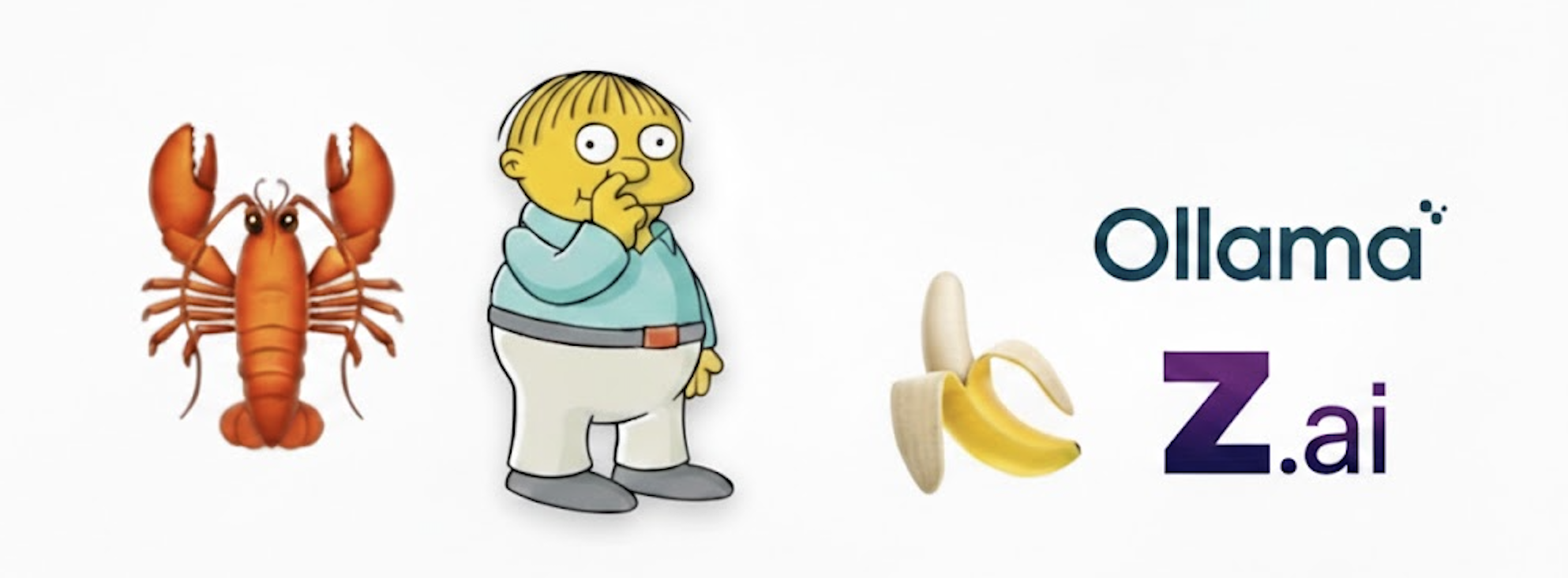
Autonomous coding agents are evolving from single-shot prompt tools into stateful, iterative systems capable of planning, executing, validating, and improving over time. The most robust designs today are composable: they separate orchestration, execution, reasoning, and inference infrastructure.
This article presents a cohesive stack built from five components:
- Openclaw — modular agent orchestration
- Ralph — iterative, file-based autonomous coding loop
- Nano Banana model — lightweight reasoning and validation
- OpenCode — structured, code-first agent actions
- Ollama + GLM-4.7-Flash — fast local LLM inference
1. MoltBot — Orchestration as a Control Plane
MoltBot functions as the control plane for autonomous agents. Its core design principle is strict separation of concerns:
- Planning / reasoning
- Memory
- Tooling
- Execution
This avoids monolithic prompts and enables deterministic, inspectable agent loops. By externalizing tools and memory, ClawdBot allows agents to operate over long horizons without relying on ever-growing context windows.
Why it matters
- Model-agnostic design (local or cloud)
- Clear observability into decisions and actions
- Easy integration with testing, linting, and CI tools
- Security best practice is to give Moltbot it own access, eg whatsapp no, email etc. Do not give Moltbod, gemibi or other AI agents access to your personal or work emails, discoard, slack etc acccess, as there are security risks of doing giving AI that access to your personal information and credentials.
2. Ralph — Persistent, Iterative Execution
Ralph introduces a critical shift in how autonomous coding agents maintain continuity:
Persist agent state on disk, not in the model context.
Ralph operates as a loop:
- Load project state from files (requirements, logs, source)
- Select the next incomplete task
- Modify code, tests, or documentation
- Record progress and outcomes
- Repeat deterministically
Key advantages
- Eliminates dependency on long context windows
- Resumable and reproducible execution
- Natural alignment with Git-based workflows
- New agent for each loop with clean context
- Clean separation between decision-making and execution
When paired with MoltBot, Ralph becomes the durable execution engine that ensures incremental, auditable progress.
3. Nano Banana — Lightweight Reasoning Where It Counts
The Nano Banana model represents a class of compact, efficient language models optimized for:
- Image generation, Planning and task decomposition
- Validation and review
- Summarization and state updates
Rather than replacing large frontier models, Nano Banana excels as a local cognitive layer inside agent loops, especially where latency, cost, or privacy constraints apply.
Typical uses
- Pre-planning before execution
- Evaluating diffs and test results
- Generating structured updates for persistent state
4. OpenCode — Structured, Code-First Actions
OpenCode introduces discipline into how agents modify code. Instead of emitting free-form text edits, OpenCode emphasizes:
- File-aware operations
- Diff-based, minimal changes
- Explicit boundaries between reasoning and action
- Deterministic tool invocation
This is essential for autonomous coding at scale. When combined with Ralph, OpenCode ensures that each iteration produces small, reviewable, and reversible diffs, dramatically reducing risk.
5. Ollama + GLM-4.7-Flash — Local Inference with Real Control
Local inference is increasingly important for:
- Cost predictability
- Data privacy
- Offline development
- Deterministic behavior
Ollama provides a clean runtime for local models, and GLM-4.7-Flash is particularly well-suited for agent workloads:
Why GLM-4.7-Flash
- Fast inference
- Strong instruction following
- Balanced reasoning vs. throughput
- Reliable as a default “daily driver” agent model
Via Ollama, GLM-4.7-Flash can serve as:
- The primary reasoning engine for ClawdBot
- The decision model inside Ralph loops
- A local-first alternative to cloud LLMs
This enables fully local autonomous coding agents with predictable performance characteristics.
6. The Unified Agent Flow
When composed, these components form a coherent architecture:
Responsibility Split
- Openclaw: planning, routing, tool coordination
- Nano Banana: lightweight reasoning and validation
- GLM-4.7-Flash: primary local reasoning model
- OpenCode: safe, structured code manipulation
- Ralph: persistent execution and progress tracking
This separation is what makes the system scalable, debuggable, and production-friendly.
7. Deployment Patterns
Local-first development
- Ollama running GLM-4.7-Flash
- Openclaw for orchestration
- Ralph for iteration
- OpenCode enforcing safe edits
Hybrid cloud / local
- Local models for planning and iteration
- Cloud models only for complex reasoning bursts
- Identical agent logic across environments
CI-driven agents
- Ralph loops triggered by CI jobs
- ClawdBot integrates tests and linters
- Deterministic diffs pushed automatically
Conclusion
Autonomous coding agents become genuinely useful when they are:
- Stateful
- Composable
- Inspectable
- Locally runnable
By combining Openclaw, Ralph, Nano Banana, OpenCode, and Ollama with GLM-4.7-Flash, you move beyond demos into real engineering workflows—agents that can reason, act, and evolve without losing context or control.
links
- Openclaw: https://github.com/Openclaw/Openclaw
- How Clawdbot Remembers Everything https://x.com/manthanguptaa/status/2015780646770323543?s=46
- Ralph: https://github.com/iannuttall/ralph
- Z.ai: https://z.ai
- opencode: https://opencode.ai/
- Ollama: https://ollama.com/
Download Ollama 0.15.2+, then download model(s) to run:
ollama pull glm-4.7-flash
ollama pull glm-4.7:cloud
ollama launch clawdbot
ollama launch opencode
ollama launch codex
ollama launch claude