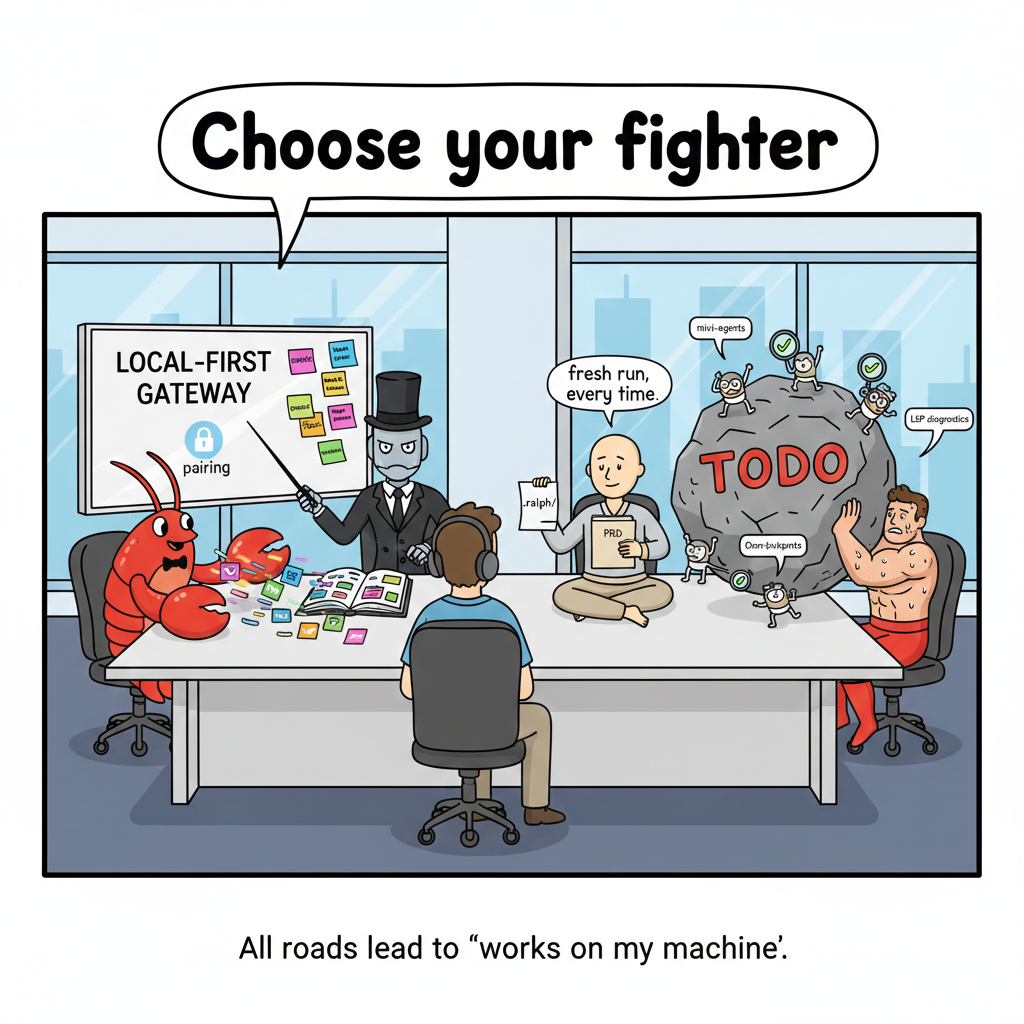
A Comparative Technical Evaluation of OpenClaw, Conductor, Ralph, and Oh-My-OpenCode
Abstract
Autonomous developer agents in 2026 are converging on one dominant architectural thesis: durable, inspectable state must live outside the model context window. The four systems evaluated here represent distinct solutions to the “agent memory, control, and trust” problem space: OpenClaw operationalizes a local-first, proactive, multi-channel assistant with a persistent control plane; Conductor formalizes Context-Driven Development (CDD) inside Gemini CLI via repo-native specs and plans; Ralph implements a minimal, file-and-git loop that hard-resets agent context each iteration; and Oh-My-OpenCode (oMo) pushes high-throughput orchestration through multi-agent delegation plus enforcement hooks that reduce partial completion. This report compares their architectural properties, security posture, and operational economics, and synthesizes a forward trajectory for stateful agentic development.
1) The Proactive Localism of OpenClaw
1.1 Identity and evolutionary pressure (naming, adoption, risk)
OpenClaw is widely described as the continuation of the viral self-hosted assistant previously known as Clawdbot and Moltbot, driven by trademark and ecosystem pressures. This rapid rebranding cycle coincided with heightened scrutiny around exposed “agent gateway” control planes and the operational risks of running tool-enabled agents on developer machines. :contentReference[oaicite:0]{index=0}
1.2 System architecture: “always-on assistant” with a control plane
OpenClaw’s defining architectural move is to behave like a long-running assistant service, not a prompt-driven CLI. The architectural center of gravity is a Gateway that functions as a control plane coordinating:
- sessions
- pairing and identity
- channel connectors (messaging apps)
- node/device integrations
- tool invocation and routing
A key implementation detail is a local WebSocket endpoint, documented in the ecosystem as defaulting to loopback on port 18789, with options to bind to LAN/tailnet or tunnel via SSH. :contentReference[oaicite:1]{index=1}
1.3 Memory and retrieval model
OpenClaw is commonly described as using structured, durable local storage for conversation/session state, plus retrieval to ground the agent’s actions in real artifacts rather than solely model priors. The design goal is reduced hallucination and increased “closed-loop” correctness by making the filesystem and indexed state queryable from inside the agent runtime.
Important caveat: many public writeups attribute specific storage choices (JSONL + SQLite + keyword FTS) to OpenClaw-like systems, but implementational details vary by fork/version and should be verified against the current repo/docs you deploy. The stable load-bearing claim is the “control plane + durable local state + retrieval” pattern, not any single schema.
1.4 Security profile: trust boundaries and real-world exposure modes
OpenClaw-class architectures expand risk because they combine:
- inbound untrusted input (DMs, group chats, webhooks)
- high-privilege tools (shell, filesystem, browser automation)
- a persistent control surface (gateway UI / WS endpoint)
Documented mitigations in the ecosystem include pairing-based acceptance flows and strong binding defaults (loopback), but the failure mode is consistent: operators expose the control plane via reverse proxies or misconfigured tunnels and unintentionally publish a privileged agent gateway to the internet. :contentReference[oaicite:2]{index=2}
1.5 OpenClaw: technical pros and cons
Pros
- Proactive “Chief of Staff” model: can monitor long-running tasks and notify via your existing channels instead of requiring interactive polling.
- Unifies comms + tooling under a single control plane: clean separation between interaction (channels) and execution (tools/models).
- Strong ergonomic upside for personal ops: once stable, the assistant becomes an always-on substrate rather than a per-task invocation.
Cons
- High operational surface area: each channel integration adds auth/permissions churn and breakage risk.
- Security posture is configuration-sensitive: control plane exposure is catastrophic if misconfigured.
- Persistent runtime requirements: heavier than CLI-only harnesses; resource and maintenance overhead increases with integrations.
2) Ralph and the Philosophy of Minimalist File-Based Loops
2.1 Core thesis: “filesystem and git are memory”
Ralph’s architecture is an explicit rejection of long-running, ever-growing agent context. Each iteration starts fresh, reads on-disk state, performs one unit of work, and commits changes. This makes the repo the canonical memory surface and constrains the model’s working set per iteration. :contentReference[oaicite:3]{index=3}
2.2 Loop design and persistence ledger
Ralph’s durable state is stored in repo-local artifacts (not model chat logs):
- PRD in JSON (stories/tasks and status)
- .ralph/ directory (logs, progress, guardrails, run summaries)
- template/prompt overrides via .agents/ralph/
This creates an auditable trail of intent and outcomes independent of any one model session. :contentReference[oaicite:4]{index=4}
2.3 Ralph: technical pros and cons
Pros
- Low drift: hard resets reduce “context poisoning” and late-stage compaction artifacts.
- High auditability: the file ledger is reviewable, diffable, and can be enforced via CI.
- Portability: minimal moving parts; shell + git + a runner command.
- Vendor agility: runner-agnostic patterns make model/provider swaps less invasive.
Cons
- Throughput ceiling: serial, one-story-per-iteration model underutilizes parallel compute for large refactors.
- Commit hygiene burden: without disciplined gating, broken intermediate commits can pollute history.
- Extensibility is intentionally limited: you’ll build your own delegation, sandboxes, and safety policies if you need more than the loop.
3) Oh-My-OpenCode: The Sisyphus Protocol and Multi-Agent Discipline
3.1 Architecture: plugin harness + orchestration primitives
Oh-My-OpenCode is positioned as an OpenCode enhancement layer offering:
- specialized agents/roles
- a large hook system
- session recovery and continuation automation
- code-quality enforcement tools (including LSP integration)
- configuration at both user and project scope
The key architectural differentiation is that behavior is shaped through hooks and “protocol” prompts rather than a single monolithic agent persona. :contentReference[oaicite:5]{index=5}
3.2 Enforcement mechanics: “Todo Continuation Enforcer”
A notable hook class automatically resumes work when the session appears idle but todo items remain incomplete. This directly addresses a common agent failure mode: stopping at ~80% with a handoff request. The system detects incompleteness and injects a continuation prompt, effectively implementing a supervision loop external to the model. :contentReference[oaicite:6]{index=6}
3.3 oMo: technical pros and cons
Pros
- High throughput via delegation: specialized agents can map, analyze, and implement in parallel.
- Hook-driven control: lifecycle hooks provide modular policy and quality enforcement without forking core logic.
- Tooling depth: strong emphasis on LSP and structured diagnostics supports large, correctness-sensitive refactors.
- Completion discipline: automated continuation reduces partial delivery and “agent stalls.”
Cons
- Complexity tax: debugging involves reasoning about agent roles, routing, hooks, toolchains, and OpenCode versions.
- Attack surface: more tools and automation paths create more potential for unsafe actions or data leakage.
- Economic efficiency risk: multi-agent orchestration and aggressive loops can be token-expensive, especially with high-tier models (this is widely reported anecdotally in community channels; measure on your workloads).
4) Conductor and the Paradigm of Context-Driven Development
4.1 CDD lifecycle: Context → Spec & Plan → Implement
Conductor is a Gemini CLI extension that formalizes a strict engineering lifecycle where durable context, specifications, and plans are written to the repo as persistent Markdown artifacts rather than living in ephemeral chat. It is explicitly presented as “Context-Driven Development.” :contentReference[oaicite:7]{index=7}
4.2 Tracks, plans, and verifiable gates
Conductor organizes work into “tracks,” each with:
- a feature/bug spec
- a phased plan
- status dashboards
The agent is constrained to execute approved plans and update artifacts as it progresses. This reduces architectural drift and increases shared-team legibility of intent.
4.3 Conductor: technical pros and cons
Pros
- Strong reproducibility: specs and plans are versioned alongside code.
- Team-friendly: shared artifacts reduce repeated prompting and enable human review at each phase.
- Process guardrails: planning-first workflow reduces chaotic, unbounded refactors.
- Brownfield alignment: designed to capture context for existing repos and preserve institutional knowledge. :contentReference[oaicite:8]{index=8}
Cons
- Protocol rigidity: high ceremony for small fixes or exploratory spikes.
- Context tax: reading and maintaining artifacts adds overhead and can increase token usage during long tasks.
- Ecosystem coupling: centered on Gemini CLI extension mechanics; portability requires re-implementing the protocol elsewhere.
5) Comparative Technical Evaluation
5.1 Architectural axes
Memory surface
- OpenClaw: durable assistant runtime state + retrieval; filesystem is a tool surface.
- Ralph: filesystem + git are the memory; each run is ephemeral.
- oMo: harness-level memory via OpenCode sessions/config plus hook-enforced process; can approximate “file-as-memory” but is more orchestration-heavy.
- Conductor: repo-native Markdown artifacts for context/spec/plan; memory is explicit and versioned. :contentReference[oaicite:9]{index=9}
Control plane vs CLI loop
- OpenClaw: persistent control plane (gateway WS).
- Ralph: deterministic CLI loop.
- oMo: plugin orchestration within OpenCode.
- Conductor: extension-driven lifecycle inside Gemini CLI.
Extensibility
- Highest: OpenClaw and oMo (integrations, hooks, tool surface).
- Medium: Conductor (templates + protocol constraints).
- Lowest by design: Ralph (simple loop, prompt templates, runner command).
5.2 Security and trust posture
Primary risk driver
- OpenClaw: exposed control plane + privileged tools + untrusted inbound messages.
- oMo: broad tool surface + automation hooks; risk depends on tool permissions and sandboxing.
- Conductor/Ralph: repo/tool permissions; primary risk is destructive code edits or credential leakage from workspace.
Typical mitigations
- Strong binding defaults and pairing flows (OpenClaw-class gateways), strict allowlists, and containerized execution for tools.
- For CLI harnesses (Ralph/Conductor), safest practice is running agents in isolated dev containers/VMs with scoped secrets and read-only mounts where possible.
5.3 Operational efficiency (human time, compute cost, throughput)
- Highest throughput potential: oMo (parallelization and continuation enforcement).
- Highest “ambient productivity” for personal workflows: OpenClaw (proactive comms and long-running assistant model).
- Highest predictability per unit work: Ralph (hard resets and tight loop).
- Highest process stability for teams: Conductor (spec/plan artifacts and enforced lifecycle).
6) Technical Synthesis and Future Trajectory (2027+)
6.1 “File-as-memory” becomes the default
Ralph and Conductor explicitly externalize state into repo artifacts; oMo enforces structured execution via todo/hook systems; OpenClaw operationalizes durable state at the assistant runtime layer. The convergent trend is stateful agentic development where memory is:
- inspectable
- diffable
- enforceable in CI
- portable across models and sessions
6.2 Developers shift from “writer” to “orchestrator and verifier”
As agent autonomy rises, engineer leverage comes from:
- writing better specs and acceptance tests
- reviewing plans and phase gates
- constraining tool permissions
- maintaining trust infrastructure (sandboxing, audit, rollback)
6.3 Token ROI drives model routing and orchestration design
High-throughput harnesses trend toward “model arbitrage”: cheap models for discovery/grep/triage, expensive models for architecture and high-risk edits. oMo’s multi-agent pattern is structurally aligned with this; Ralph/Conductor can adopt it by swapping runners or delegating subtasks to specialized prompts.
7) Concluding Technical Assessment
OpenClaw is the frontier of “assistant as an always-on system,” with substantial ergonomic upside and equally substantial security responsibilities, especially around gateway exposure. :contentReference[oaicite:10]{index=10}
Ralph is the cleanest expression of “ephemeral agent, durable repo state,” trading throughput for correctness and auditability. :contentReference[oaicite:11]{index=11}
Oh-My-OpenCode prioritizes disciplined completion and orchestration power through hooks, multi-agent roles, and continuation enforcement, at the cost of complexity and potentially high compute burn. :contentReference[oaicite:12]{index=12}
Conductor professionalizes agentic coding with a strict spec-and-plan lifecycle and persistent artifacts that teams can share and enforce, accepting protocol rigidity as the price of stability. :contentReference[oaicite:13]{index=13}
References (source URLs are provided via citations in-text)
Notes
- OpenClaw rebrand reporting and gateway exposure narratives vary across outlets; rely on the repo/docs you deploy and treat third-party setup guides as non-authoritative.
- Community cost claims (token burn, “bloated hooks”) should be validated empirically on your workload; measure with a fixed benchmark suite and consistent tool permissions.