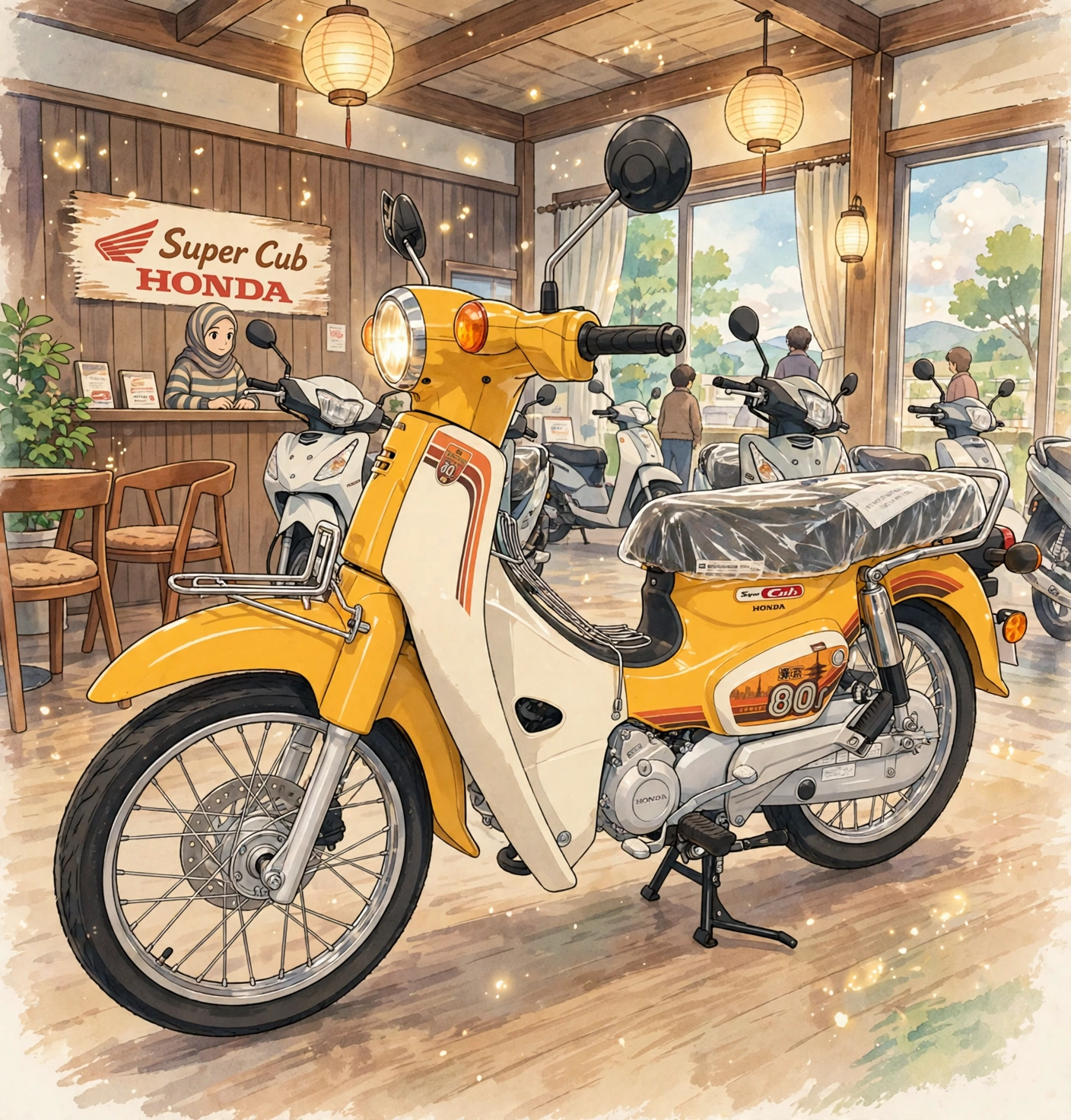
2026 Honda Super Cub 110 Thailand: A Timeless Motorcycle That Bridges Japanese Heritage and Modern Everyday Riding
Introduction: The Motorcycle That Became a Global Icon
Few motorcycles in history have achieved the cultural significance, worldwide recognition and enduring popularity of the Honda Super Cub. Since its introduction in 1958, this small Japanese motorcycle has evolved from an affordable everyday transport solution into one of the most recognisable motorcycles ever produced.
More than six decades later, the Super Cub remains an important part of Honda’s global motorcycle portfolio. Its distinctive combination of a step-through frame, leg shields, economical four-stroke engine, practical design and approachable riding characteristics has allowed it to remain relevant across generations.
In Thailand, the Honda Super Cub occupies a particularly interesting position. The country has a strong motorcycle culture, with small-capacity motorcycles serving millions of people as everyday transportation. Honda’s family motorcycles, particularly the Wave series, are familiar sights on Thai roads. However, the Super Cub offers something different: a blend of classic Japanese styling, modern engineering and nostalgic character.
The 2026 Thai-market Super Cub 110 continues this philosophy. It retains the traditional silhouette that made the original famous while incorporating modern features such as electronic fuel injection, LED lighting, a digital information display and an updated braking system with a front disc brake and Combined Brake System (CBS).
Priced at approximately 50,600 baht, the Super Cub is positioned above conventional entry-level family motorcycles. Its appeal is not simply about transportation or affordability. It is also about design, heritage, individuality and the enjoyment of owning a motorcycle with a genuinely distinctive identity.
This review explores the Super Cub’s remarkable history, the latest Thai-market model, its engine and technical specifications, riding characteristics, fuel economy, ownership costs, available colours and its position against the Honda Wave 110.
1. The History of the Honda Super Cub: From 1958 to 2026
The Birth of an Icon in 1958
The Honda Super Cub story began in post-war Japan, when affordable personal transportation was becoming increasingly important.
Honda founders Soichiro Honda and Takeo Fujisawa recognised an opportunity to develop a motorcycle that was more accessible and easier to operate than conventional motorcycles. Their objective was to create a practical vehicle that could be used by almost anyone, regardless of riding experience.
The result was the original Honda Super Cub C100, introduced in August 1958.
<INSERT IMAGE: 1958 Honda Super Cub C100 original motorcycle>
The C100 featured a 49cc air-cooled, four-stroke, single-cylinder OHV engine producing approximately 4.5 horsepower. It used a three-speed transmission with an automatic centrifugal clutch, eliminating the need for a conventional manual clutch lever.
This was a significant innovation for its time.
The motorcycle also introduced several design characteristics that would become permanent Super Cub trademarks:
- A low step-through frame for easy mounting and dismounting.
- Large front leg shields to protect riders from wind, dirt and road debris.
- A compact, economical four-stroke engine.
- An automatic centrifugal clutch.
- A comfortable riding position.
- Simple mechanical construction designed for durability and easy maintenance.
Honda had created something between a conventional motorcycle and a scooter: a practical, lightweight machine with the efficiency of a small motorcycle and the convenience of automatic clutch operation.
The concept proved extremely successful.
1959: Entering the American Market
One year after its Japanese introduction, Honda began exporting the Super Cub to the United States.
The American market was very different from Japan. Motorcycles were often associated with recreational riding and larger machines rather than everyday family transportation.
Honda helped change this perception by marketing its smaller motorcycles as friendly, economical and accessible transportation.
The famous advertising campaign, “You Meet the Nicest People on a Honda”, helped establish a new image for motorcycling.
The Super Cub became an important part of Honda’s international expansion.
The Evolution of the C50, C65, C70 and C90
During the 1960s and 1970s, Honda continued developing the Super Cub family.
Several important versions appeared:
| Model | Period | Main development |
|---|---|---|
| Super Cub C100 | 1958 | Original 49cc OHV model |
| Super Cub C105 | 1961 | Larger-displacement development |
| Super Cub C65 | 1964 | Introduction of an OHC engine |
| Super Cub C50 | 1966 | 50cc OHC development |
| Super Cub C70 | 1969 | Larger 72cc engine |
| Super Cub C90 | Late 1960s onward | Larger 89cc engine |
The introduction of overhead-camshaft engines improved the mechanical architecture of the Super Cub range.
The C50, C70 and C90 became particularly recognisable models, with millions of motorcycles sold across different international markets.
These motorcycles helped establish the Super Cub as a dependable vehicle for commuting, commercial deliveries and everyday family transportation.
1960s–1980s: Expansion Across Asia
The Super Cub’s success extended well beyond Japan.
Honda established production operations and expanded distribution throughout Asia, including Thailand and other Southeast Asian countries.
In these markets, the motorcycle became an important transportation tool for workers, students, small businesses and families.
Its practical design was especially suitable for countries where motorcycles were used for almost every aspect of everyday life.
Thailand developed a particularly strong relationship with Honda’s small-capacity motorcycles. The Cub concept became part of the foundation for Honda’s family motorcycle business in the region.
Over time, local-market derivatives and related models evolved to meet different customer requirements.
1980s–2000s: Modernisation and Fuel Injection
As motorcycle technology advanced, Honda continued updating the Super Cub.
Improvements included:
- More efficient four-stroke engines.
- Improved fuel consumption.
- Better electrical systems.
- Modernised chassis components.
- Improved reliability.
- Electronic fuel injection on selected models.
In 2007, Honda introduced PGM-FI electronic fuel injection to selected Super Cub models, improving fuel delivery and helping meet increasingly demanding emissions requirements.
In 2009, the modern Super Cub 110 was introduced, bringing a larger engine and updated mechanical components while retaining the familiar step-through concept.
2018: The Premium Super Cub C125
<INSERT IMAGE: Honda Super Cub C125 2018 modern classic motorcycle>
The launch of the Super Cub C125 in 2018 marked another important chapter.
Rather than focusing exclusively on low-cost transportation, Honda developed a more premium interpretation of the classic Super Cub.
The C125 featured:
- A larger 125cc-class engine.
- More refined bodywork.
- Premium finishing.
- Modern electronic equipment.
- Improved suspension and braking components.
- A more sophisticated overall appearance.
It demonstrated that the Super Cub could appeal to lifestyle and enthusiast buyers as well as traditional commuters.
2017: Reaching 100 Million Units
In October 2017, Honda announced that cumulative worldwide production of the Super Cub series had reached 100 million units.
This was an extraordinary achievement for a motorcycle family.
The milestone demonstrated the importance of the Super Cub in Honda’s history and its influence on affordable personal transportation worldwide.
The series had become more than a motorcycle. It was a global transportation phenomenon.
2026: Continuing the Original Philosophy
The modern Thai-market Super Cub 110 continues the philosophy established by the original C100.
It combines:
- Classic step-through styling.
- A fuel-efficient 109.5cc engine.
- Four-speed rotary transmission.
- Lightweight construction.
- Modern LED lighting.
- Electronic fuel injection.
- Updated braking technology.
The result is a motorcycle that maintains its traditional identity without being technologically outdated.
2. 2026 Honda Super Cub 110 Thailand: Design and Styling
<INSERT IMAGE: 2026 Honda Super Cub 110 Thailand front three-quarter view>
The most distinctive feature of the Super Cub is its design.
While many modern motorcycles adopt aggressive bodywork, sharp angles and sporty styling, the Super Cub deliberately retains a softer and more traditional appearance.
Its rounded headlight, curved front mudguard, enclosed body panels and step-through frame immediately identify it as a member of the Super Cub family.
Honda has resisted the temptation to modernise the design excessively.
Classic Round LED Headlight
The front headlight is one of the motorcycle’s most recognisable features.
The round headlight maintains the traditional appearance of the original Super Cub while incorporating modern LED lighting technology.
LED lighting offers several advantages:
- Efficient electrical consumption.
- Long operating life.
- Clear illumination.
- A modern lighting signature.
- Reduced maintenance compared with conventional bulbs.
The circular design also works particularly well with the classic mirrors and rounded front bodywork.
Front Leg Shields
The Super Cub’s large leg shields are not merely decorative.
They are an important part of the motorcycle’s original engineering concept.
The shields help protect the rider’s lower body from wind, road debris and water splashes.
This is particularly useful in Thailand, where riders regularly encounter tropical rain, dusty roads and varying road conditions.
The design also gives the Super Cub its characteristic enclosed appearance.
Step-Through Frame
The step-through frame remains one of the Super Cub’s most practical features.
Unlike conventional motorcycles with a high central fuel tank and frame, the Super Cub allows riders to mount and dismount without lifting a leg over a high seat.
This makes it particularly convenient for:
- Everyday commuting.
- Riders wearing formal clothing.
- Older riders.
- Short-distance urban transportation.
- Frequent stops in congested traffic.
The relatively low 744mm seat height also makes the motorcycle accessible to a broad range of riders.
Seat and Passenger Accommodation
The Super Cub features a long, single-piece seat designed for everyday use.
Its relatively upright riding position is comfortable for ordinary commuting, while the rear grab rail provides a practical handhold for passengers.
The motorcycle is not designed as a touring machine, but it can comfortably handle short journeys with a passenger, subject to its rated load capacity.
Wheels and Overall Appearance
The Thai-market Super Cub retains traditional spoke wheels.
The 17-inch wheel configuration contributes to its classic appearance and helps maintain the familiar proportions of the original design.
The overall styling is deliberately understated.
Rather than attempting to look like a modern sport motorcycle, the Super Cub celebrates its own identity.
3. Available Colours in Thailand
Honda has introduced several attractive colour combinations for the Thai-market Super Cub.
For the current model covered in this review, the standard range has four listed colours.
| Colour | Character |
|---|---|
| Yellow-White (Y-W) | Bright retro appearance |
| Sky Blue-White (SBW) | Classic Japanese-inspired styling |
| Grey-White (G-W) | Subtle and sophisticated |
| Green (GRN) | Traditional, understated appearance |
<INSERT IMAGE: Four-colour Honda Super Cub 110 Thailand colour comparison>
The two-tone colour combinations are particularly attractive because they reinforce the motorcycle’s vintage character.
The blue-and-white and yellow-and-white versions have a distinctly nostalgic appearance, while the green version provides a simpler, more traditional look.
Are there seven colours?
Not for this standard Thai-market model according to the current four-colour listing. Colour availability can change with model-year updates, special editions and dealer stock.
It is also important not to confuse the Thai-market colours with those offered in Japan or other international markets.
4. Engine and Technical Specifications
At the heart of the 2026 Thai-market Super Cub is Honda’s 109.5cc Honda Smart Engine.
It is a single-cylinder, four-stroke, air-cooled engine equipped with electronic fuel injection.
The engine is designed around reliability, economical operation and straightforward everyday performance rather than high-speed acceleration.
Engine Configuration
The engine uses a single overhead camshaft (SOHC) arrangement with a two-valve cylinder head.
Fuel is delivered through Honda’s PGM-FI electronic fuel-injection system.
The air-cooled configuration avoids the complexity and additional weight associated with liquid-cooling equipment.
For a small-capacity commuter motorcycle, this is a sensible engineering approach.
Technical Specifications
| Specification | 2026 Honda Super Cub 110 Thailand |
|---|---|
| Engine type | 4-stroke, single-cylinder, SOHC |
| Cooling | Air-cooled |
| Displacement | 109.5cc |
| Fuel system | PGM-FI electronic fuel injection |
| Transmission | 4-speed rotary |
| Clutch | Automatic centrifugal-type operation |
| Starting system | Electric starter |
| Fuel type | Petrol / compatible gasohol |
| Fuel tank capacity | 4.2 litres |
| Front brake | Hydraulic disc with CBS |
| Rear brake | Drum |
| Front suspension | Telescopic fork |
| Rear suspension | Swingarm with twin shock absorbers |
| Front tyre | 70/90-17 |
| Rear tyre | 80/90-17 |
| Seat height | 744mm |
| Wheelbase | 1,224mm |
| Ground clearance | 132mm |
| Kerb weight | Approximately 98kg |
Specifications are based on Thai-market dealer and model information. Equipment and fuel compatibility should be confirmed against the individual motorcycle’s owner’s manual.
Engine Performance
The 109.5cc engine is designed for moderate-speed operation.
It provides sufficient performance for:
- Urban commuting.
- Local shopping.
- Short intercity journeys.
- Rural roads.
- Everyday transportation.
The lightweight 98kg motorcycle helps the relatively small engine deliver an acceptable power-to-weight ratio for its intended role.
However, buyers should understand that the Super Cub is not designed for high-speed highway riding.
Its engine capacity and power delivery are better suited to Thailand’s urban streets, local roads and moderate-speed routes.
Four-Speed Rotary Transmission
One of the defining characteristics of the Super Cub is its four-speed rotary transmission.
Unlike a conventional motorcycle gearbox, the transmission is operated using a foot-operated gear selector without a manual clutch lever.
The centrifugal clutch automatically engages and disengages as engine speed changes.
This arrangement provides a useful combination of motorcycle-style gear selection and scooter-like convenience.
The rider still has control over gear selection, but does not need to operate a conventional clutch lever.
For new riders, this can make the Super Cub considerably easier to learn than a traditional manual motorcycle.
5. Riding Performance and Everyday Practicality
The Super Cub’s riding experience is fundamentally different from that of a conventional scooter or sport motorcycle.
Its design prioritises ease of use, predictable handling and economical transportation.
Urban Riding
The motorcycle’s lightweight construction is particularly useful in congested Thai cities.
At approximately 98kg, it is relatively easy to manoeuvre, park and move around at low speeds.
The narrow body and upright riding position provide good visibility and make it easy to negotiate traffic.
In Bangkok, Chiang Mai, Phuket and other Thai cities, these characteristics are useful for everyday journeys.
The Super Cub is especially suitable for riders who travel relatively short distances and frequently stop at shops, markets and residential areas.
Handling and Stability
The 17-inch wheels provide a traditional motorcycle riding experience.
Compared with some small-wheeled scooters, the Super Cub has proportions that are more closely associated with conventional motorcycles.
Its telescopic front suspension and twin rear shock absorbers are designed for everyday road conditions.
The relatively lightweight chassis also makes direction changes easy.
However, the suspension should not be expected to provide the refinement of a larger motorcycle.
On badly maintained roads, potholes and rough surfaces, riders should maintain appropriate speeds.
Riding Position
The Super Cub offers a relaxed and upright riding position.
The handlebars are positioned to provide easy access without requiring the rider to lean forward aggressively.
The relatively low seat height makes it easier to place both feet on the ground.
This is a useful characteristic for beginners and riders who prefer a more relaxed motorcycle.
Passenger Use
The long seat and rear grab rail make the Super Cub suitable for occasional passenger use.
However, the motorcycle’s modest engine capacity means that acceleration and climbing performance will be reduced when carrying two adults.
For regular passenger use, riders should consider whether a larger-capacity family motorcycle would be more suitable.
Is It Suitable for Long-Distance Riding?
The Super Cub can undertake longer journeys, but it is not primarily designed as a touring motorcycle.
Its strengths are:
- Low operating costs.
- Simple mechanical construction.
- Comfortable upright ergonomics.
- Economical fuel consumption.
- Easy handling.
Its limitations include:
- Modest engine output.
- Limited high-speed performance.
- Small fuel tank.
- Limited luggage capacity.
- Greater exposure to weather than a fully enclosed scooter.
For leisurely countryside rides and scenic routes through Thailand, however, the Super Cub can be an enjoyable companion.
It encourages a slower style of travel, allowing riders to experience local communities, rural landscapes and smaller roads.
6. Fuel Economy and Riding Range
Fuel economy is one of the most important reasons why the Super Cub remains relevant.
Honda’s small-capacity engines have traditionally prioritised economical operation, and the latest Thai-market model continues this approach.
The reported fuel-economy figure for the current model is up to approximately 71.4km per litre, based on the applicable Thai testing standard.
This is an impressive theoretical figure for a petrol-powered motorcycle.
Actual consumption will depend on:
- Rider weight.
- Passenger weight.
- Road conditions.
- Traffic congestion.
- Riding speed.
- Acceleration habits.
- Tyre pressure.
- Maintenance condition.
Fuel Tank Capacity
The Super Cub has a fuel tank capacity of approximately 4.2 litres.
Using the reported maximum fuel-economy figure:
[
4.2 \times 71.4 = 299.88\text{ km}
]
This produces a theoretical maximum riding range of approximately 300km.
In everyday conditions, a more conservative range should be expected.
| Measurement | Estimated figure |
|---|---|
| Fuel tank capacity | 4.2 litres |
| Published economy | 71.4km/L |
| Fuel consumption per 100km | 1.40 litres |
| Theoretical maximum range | 300km |
| Practical planning range | Approximately 220–270km |
The practical range is an illustrative planning estimate rather than a guaranteed test result.
Fuel Consumption Calculation
At the published 71.4km/L figure:
[
100 \div 71.4 = 1.40\text{ litres}
]
Therefore, the motorcycle uses approximately 1.40 litres of petrol for every 100km under the stated test conditions.
This makes it an economical option for people who commute regularly.
Estimated Fuel Costs
The following table illustrates fuel costs at different petrol prices.
| Petrol price | Cost per 100km | Cost per 1,000km |
|---|---|---|
| ฿35/L | ฿49 | ฿490 |
| ฿40/L | ฿56 | ฿560 |
| ฿45/L | ฿63 | ฿630 |
| ฿50/L | ฿70 | ฿700 |
These calculations use the published 71.4km/L figure. Actual costs will be higher if real-world fuel economy is lower.
For someone travelling 20,000km annually, the theoretical fuel consumption would be approximately 280 litres.
At ฿40 per litre, that would represent approximately ฿11,200 in annual fuel expenditure.
This illustrates why small-capacity motorcycles remain attractive for everyday transportation in Thailand.
7. Features and Equipment
Although the Super Cub retains its classic appearance, the latest Thai-market model incorporates several modern features.
LED Lighting
The round LED headlight combines traditional styling with modern lighting technology.
It provides a distinctive appearance while reducing electrical consumption.
Digital LCD Information Display
The instrument panel combines traditional styling with a digital LCD information display.
It provides useful riding information in a compact format.
This is a good example of how Honda has introduced modern technology without significantly changing the motorcycle’s overall appearance.
Honda PGM-FI
The electronic fuel-injection system automatically manages fuel delivery according to engine operating conditions.
Its benefits include:
- More precise fuel metering.
- Consistent engine operation.
- Improved cold-start behaviour.
- Better fuel efficiency potential.
- Reduced emissions compared with older carburetted systems.
Front Disc Brake and CBS
One of the important developments in the latest Thai-market Super Cub is the introduction of a front disc brake and Combined Brake System.
The front hydraulic disc provides improved braking hardware compared with a traditional drum-only arrangement.
CBS distributes braking force between the front and rear braking systems when the linked braking control is operated.
This helps provide more balanced braking under normal operating conditions.
However, CBS is not equivalent to ABS.
Classic Mirrors and Bodywork
Honda has retained the traditional circular mirrors and familiar body proportions.
These details are important because the Super Cub’s identity is closely associated with its original design.
Practical Everyday Equipment
The Super Cub focuses on essential equipment rather than extensive electronic technology.
It is not intended to compete with premium scooters offering large under-seat storage, keyless ignition or advanced connectivity.
Its appeal lies in a simpler and more traditional ownership experience.
8. CBS vs ABS: Understanding the Difference
One important consideration when buying the latest Super Cub is its braking technology.
The Thai-market model features CBS, or Combined Brake System.
Some international Honda motorcycles are equipped with ABS, or Anti-lock Braking System.
Although both systems are designed to improve braking safety, they perform different functions.
What Is CBS?
CBS links braking force between the front and rear wheels.
When the rider operates the linked braking control, the system distributes braking force between both wheels according to its design.
The objective is to provide more balanced braking and reduce the likelihood of relying excessively on one brake.
Advantages include:
- More balanced braking.
- Simpler operation.
- Improved braking confidence for less-experienced riders.
- Useful everyday braking assistance.
However, CBS does not prevent the wheels from locking under heavy braking.
What Is ABS?
ABS monitors wheel rotation and detects when a wheel is approaching a lock-up condition.
The system then regulates hydraulic brake pressure to help maintain wheel rotation.
This is particularly valuable during emergency braking or when braking on slippery surfaces.
Advantages include:
- Reduced likelihood of wheel lock-up.
- Improved steering control during hard braking.
- Greater braking confidence on low-grip surfaces.
- Additional assistance during emergency stops.
CBS vs ABS Comparison
| Feature | CBS | ABS |
|---|---|---|
| Full name | Combined Brake System | Anti-lock Braking System |
| Main function | Distributes braking force | Prevents wheel lock-up |
| Links front and rear brakes | Yes, according to system design | Not necessarily |
| Helps prevent wheel lock-up | No | Yes |
| Emergency braking assistance | Limited | More advanced |
| Particularly useful for | Everyday braking balance | Hard braking and slippery conditions |
| Mechanical complexity | Generally simpler | More complex |
| Available on Thai Super Cub | Yes | No |
Important: The 2026 Thai-market Super Cub 110 discussed here uses CBS, not ABS.
CBS should not be mistaken for an anti-lock braking system.
Riders should still use progressive braking, maintain appropriate following distances and adjust their speed to road conditions.
9. Thailand Pricing: How Much Does the 2026 Super Cub Cost?
The Thai-market Super Cub is positioned as a lifestyle-oriented family motorcycle rather than the cheapest possible commuter.
The standard model has a recommended price of approximately:
<INSERT IMAGE: 2026 Honda Super Cub Thailand four-colour model>
฿50,600 (50,600 Thai baht)
The FUJISAN Limited Edition was introduced at approximately ฿54,000, while other special-edition pricing and availability may vary.
Thai-Market Price Overview
| Model | Indicative recommended price |
|---|---|
| Honda Super Cub 110 Standard | ฿50,600 |
| Super Cub FUJISAN Limited Edition | ฿54,000 |
Prices should be checked with an authorised Honda Wing Center before purchase. Registration, compulsory insurance, dealer charges and promotions may affect the final on-the-road price.
Is the Super Cub Expensive?
Compared with the Honda Wave 110, the Super Cub is more expensive.
However, the difference is partly explained by its distinctive styling, heritage and equipment.
The Super Cub is not simply intended to be the cheapest motorcycle in its category.
It targets buyers who value the design and character of a classic Honda motorcycle.
10. Maintenance and Running Costs
The Super Cub’s small air-cooled engine and relatively simple mechanical layout help keep ownership manageable.
However, low fuel consumption is only one part of the ownership equation.
Owners should also budget for regular maintenance and consumable parts.
Engine Oil
Regular engine oil changes are essential for maintaining engine lubrication and reducing mechanical wear.
Owners should follow the maintenance intervals and oil specifications in the Thai-market owner’s manual.
Air Filter
The air filter should be inspected and replaced according to the service schedule.
Dusty rural roads and heavily polluted urban environments can increase the importance of regular inspection.
Spark Plug
The spark plug is an important component of the ignition system.
A worn or fouled spark plug can cause starting problems, poor running and reduced fuel efficiency.
Chain and Sprockets
Unlike a belt-driven scooter, the Super Cub uses a conventional chain final drive.
The chain requires periodic:
- Cleaning.
- Lubrication.
- Tension adjustment.
- Wear inspection.
The front and rear sprockets should also be inspected.
Tyres and Brakes
The motorcycle uses relatively narrow tyres, which are generally economical to replace.
Brake pads, rear brake shoes and tyres are normal consumables.
Because the Thai model has a front disc and rear drum arrangement, owners should inspect both systems regularly.
Estimated Maintenance Categories
| Maintenance item | Typical ownership requirement |
|---|---|
| Engine oil | Periodic replacement |
| Air filter | Inspection and replacement |
| Spark plug | Periodic inspection |
| Drive chain | Cleaning, lubrication and adjustment |
| Sprockets | Inspection and replacement when worn |
| Front brake pads | Replacement when worn |
| Rear brake shoes | Replacement when worn |
| Tyres | Replacement according to wear and age |
| Battery | Inspection and eventual replacement |
Actual service costs depend on the dealer, location, labour rates and parts prices.
For buyers in Thailand, Honda’s extensive dealer and service network is a significant ownership advantage.
11. Honda Super Cub vs Honda Wave 110: Which Is Better?
<INSERT IMAGE: Honda Super Cub 110 beside Honda Wave 110 Thailand>
The Honda Super Cub and Honda Wave 110 belong to the same broad family-motorcycle category, but they appeal to different buyers.
The Wave is primarily designed around practical everyday transportation and value.
The Super Cub places greater emphasis on heritage, styling and individuality.
Comparison Table
| Specification | Super Cub 110 | Wave 110 |
|---|---|---|
| Engine displacement | 109.5cc | 109.5cc |
| Engine type | Air-cooled, 4-stroke | Air-cooled, 4-stroke |
| Fuel injection | PGM-FI | PGM-FI |
| Transmission | 4-speed rotary | 4-speed semi-automatic |
| Fuel tank | 4.2 litres | 5 litres |
| Seat height | 744mm | Market/version dependent |
| Weight | Approximately 98kg | Version dependent |
| Braking | Front disc CBS, rear drum | Varies by version |
| Styling | Retro classic | Modern family motorcycle |
| Main appeal | Heritage and individuality | Practicality and value |
| Starting price | ฿50,600 | From approximately ฿39,000 for the 2026 range |
The Wave 110 price range depends on the selected wheel, starter and brake configuration.
Honda Wave 110: The Practical Choice
The Wave is generally the more economical option.
It is particularly suitable for:
- Daily commuting.
- Delivery work.
- Family transportation.
- Frequent commercial use.
- Buyers prioritising affordability.
Its practical body design and larger fuel tank make it a strong everyday transportation choice.
Honda Super Cub: The Lifestyle Choice
The Super Cub appeals to people who appreciate traditional Japanese motorcycle design.
Its distinctive appearance makes it more recognisable than the conventional Wave.
It is particularly attractive to:
- Classic motorcycle enthusiasts.
- Collectors.
- Riders who enjoy retro styling.
- People seeking a distinctive everyday motorcycle.
- Travellers who enjoy relaxed countryside riding.
Which One Should You Buy?
Choose the Honda Wave if affordability and practical transportation are your primary considerations.
Choose the Super Cub if you want a motorcycle that combines everyday usability with classic styling and a stronger sense of identity.
The Super Cub is more than a basic commuter. It is a motorcycle with a history and design language that few competitors can reproduce.
12. Special Editions: FUJISAN and the Super Cub Lifestyle
<INSERT IMAGE: Honda Super Cub FUJISAN Limited Edition Thailand>
Honda has also introduced special editions to appeal to enthusiasts and collectors.
One notable example is the Super Cub FUJISAN Limited Edition, launched in Thailand in 2025.
The motorcycle takes inspiration from Japan’s Mount Fuji and the country’s traditional visual identity.
Its special equipment includes:
- Blue front windscreen.
- Fuji-inspired body graphics.
- Front carrier.
- Coordinated blue accessories.
- Special edition styling details.
Honda announced production was limited to 500 units nationwide.
The recommended launch price was approximately ฿54,000.
This version demonstrates how Honda has expanded the Super Cub beyond its original transportation role.
The motorcycle has become a lifestyle product with an enthusiast following.
Special editions also provide opportunities for owners to express their individuality through distinctive paint schemes and accessories.
13. The Honda Super Cub in Thailand: More Than Just Transportation
Thailand has a long relationship with small-capacity Honda motorcycles.
Motorcycles are used extensively for commuting, school transportation, shopping, deliveries and local business activities.
In this environment, the Super Cub has a particular cultural appeal.
It combines the practicality expected of a small Thai-market motorcycle with a visual identity associated with Japanese design and engineering.
Urban Commuting
For city residents, the Super Cub offers a lightweight alternative to larger scooters.
It is easy to park and manoeuvre, and its fuel consumption makes it suitable for regular commuting.
Rural Thailand
The Super Cub is also well suited to rural environments.
Its upright riding position and relatively simple mechanical design make it suitable for travelling between villages, local markets and smaller towns.
However, it should not be confused with an off-road motorcycle.
Tourism and Scenic Riding
For motorcycle enthusiasts visiting Thailand, the Super Cub represents an interesting way to experience the country.
Its modest performance encourages relaxed travel rather than high-speed riding.
It is particularly suitable for scenic routes, coastal roads and countryside exploration.
Some interesting destinations for relaxed motorcycle journeys include:
- Chiang Mai and the surrounding mountain roads.
- The countryside around Chiang Rai.
- Coastal roads in Prachuap Khiri Khan.
- The rural landscapes of Nakhon Ratchasima.
- Smaller roads around Kanchanaburi.
- The coastal communities of southern Thailand.
For these journeys, the Super Cub offers a different experience from larger touring motorcycles.
It encourages riders to slow down, explore smaller communities and appreciate the surroundings.
14. Pros and Cons of the 2026 Honda Super Cub 110
Advantages
1. Timeless design
The Super Cub has one of the most recognisable motorcycle designs in history. Its appearance remains distinctive without relying on aggressive styling.
2. Excellent fuel economy
The reported 71.4km/L fuel-economy figure makes it an attractive option for economical daily transportation.
3. Lightweight construction
At approximately 98kg, it is easy to manoeuvre and park.
4. Accessible seat height
The 744mm seat height makes it approachable for a broad range of riders.
5. Simple operation
The centrifugal clutch and rotary transmission make it easier to operate than a conventional manual motorcycle.
6. Modern fuel injection
PGM-FI provides efficient and consistent fuel delivery.
7. Improved braking equipment
The addition of a front disc brake and CBS is a useful improvement over older drum-brake configurations.
8. Strong heritage
Few motorcycles can match the Super Cub’s history and global recognition.
9. Practical everyday design
The step-through frame and leg shields remain useful features.
10. Strong Honda service network
Honda’s extensive presence in Thailand makes servicing and obtaining replacement parts relatively convenient.
Disadvantages
1. Limited engine performance
The 109.5cc engine is designed for everyday commuting rather than high-speed travel.
2. No ABS
CBS improves braking balance but does not provide anti-lock braking protection.
3. Small fuel tank
The 4.2-litre tank is adequate for commuting but relatively small for longer journeys.
4. Limited storage
The Super Cub does not offer the large under-seat storage compartment found on many automatic scooters.
5. Premium price compared with the Wave
Buyers primarily interested in transportation value may find the Honda Wave more attractive.
6. Limited high-speed comfort
Long-distance highway journeys are not the Super Cub’s strongest application.
7. Modest passenger performance
Carrying two adults reduces acceleration and climbing performance.
15. Who Should Buy the 2026 Honda Super Cub?
The Super Cub is not necessarily the right motorcycle for everyone.
Its appeal depends on what the buyer values.
First-Time Motorcycle Buyers
The lightweight construction, low seat and centrifugal clutch make it an approachable motorcycle for new riders.
However, beginners should still receive proper riding instruction and understand the local licensing requirements.
Daily Commuters
For people travelling relatively short distances every day, the Super Cub offers low fuel consumption and practical operation.
Classic Motorcycle Enthusiasts
The Super Cub is particularly attractive to enthusiasts who appreciate Japanese motorcycle history.
Its appearance connects the latest model directly with the original C100.
Lifestyle Buyers
Some buyers simply want a motorcycle that looks different from the many conventional scooters and family motorcycles on Thai roads.
The Super Cub provides that individuality.
Collectors
Special editions and the model’s historical significance make the Super Cub interesting to collectors.
However, the standard model should be considered primarily as a usable motorcycle rather than an investment.
16. Final Verdict: A Classic That Still Makes Sense in 2026
The 2026 Honda Super Cub 110 demonstrates that a motorcycle does not need to be powerful, complicated or technologically excessive to remain desirable.
Its success comes from a simple idea that Honda has refined over more than six decades: create an economical, reliable and approachable motorcycle that people enjoy using.
The latest Thai-market model retains the original Super Cub identity while introducing useful modern features.
The 109.5cc PGM-FI engine provides economical everyday performance, while the four-speed rotary transmission and centrifugal clutch make operation straightforward.
The lightweight chassis and low seat height contribute to easy handling, and the front disc brake with CBS offers a welcome improvement over older braking arrangements.
Its reported fuel economy of up to 71.4km/L also makes it an attractive choice for people concerned about daily running costs.
There are limitations, of course.
The Super Cub is not particularly fast, its storage capacity is limited, and it does not offer ABS. Buyers looking for maximum practicality and value may find the Honda Wave 110 a more logical purchase.
Nevertheless, the Super Cub offers something the Wave cannot entirely replicate: an unmistakable design, a remarkable heritage and a distinctive riding experience.
For Thailand, where motorcycles remain an essential part of everyday transportation, the Super Cub represents an appealing combination of tradition and modern convenience.
It is not simply a motorcycle from the past that has survived into the present.
It is a classic design that continues to serve a practical purpose.
The Honda Super Cub remains proof that good design, thoughtful engineering and everyday usability can create a motorcycle that lasts for generations.
17. Key Specifications and Quick Reference
| Item | Details |
|---|---|
| Model | Honda Super Cub 110 |
| Model year | 2026 Thai-market model |
| Manufacturer | Honda |
| Engine | 109.5cc, single-cylinder, 4-stroke |
| Cooling | Air-cooled |
| Fuel injection | PGM-FI |
| Transmission | 4-speed rotary |
| Clutch | Automatic centrifugal operation |
| Fuel tank | 4.2 litres |
| Published fuel economy | Up to 71.4km/L |
| Theoretical fuel range | Approximately 300km |
| Front brake | Hydraulic disc with CBS |
| Rear brake | Drum |
| Front suspension | Telescopic |
| Rear suspension | Twin shock absorbers |
| Seat height | 744mm |
| Wheelbase | 1,224mm |
| Ground clearance | 132mm |
| Weight | Approximately 98kg |
| Standard colours | Four |
| Thai recommended price | ฿50,600 |
Specifications and pricing are indicative of the Thai-market model and may change with subsequent model-year updates.
Sources and Further Reading
- Honda Global – Super Cub History and Models
- Honda Global – 1958 Super Cub C100
- Honda Global – 100 Million-Unit Production Milestone
- Honda Global – 50th Anniversary of the Super Cub
- Autoinfo Thailand – All New Honda Super Cub and FUJISAN Limited Edition
- Honda Super Cub Thailand – Model and Specifications
- Thai Honda Super Cub 110 – 2026 Specifications and Pricing
Editorial note: Prices, specifications, colour availability and equipment should be reconfirmed with Thai Honda or an authorised Honda Wing Center before publication. The published fuel-economy figure is a test-cycle result, not a guaranteed real-world consumption figure.
Publication notes:
- Article uses the Thai-market four-colour specification, not the Japanese-market colour range.
- The 71.4 km/L figure is the published test figure, not guaranteed real-world consumption.
- The FUJISAN edition is distinguished from the standard model.
- CBS and ABS are explained separately to avoid confusing the two technologies.
The historical background is supported by Honda’s official corporate history, including its 100-million-unit production milestone.
Honda Global Corporate Website+3
The article covers the 2026 Honda Super Cub 110 in Thailand, combined with the history of the Super Cub from its original 1958 C100 to the modern generation.
One important market distinction: the Thai-market Super Cub is different from the Japanese-market 2026 model. I will use Thai-market specifications, prices and colours rather than mixing specifications from other countries.
The current Thai-market model is listed at ฿50,600, with a 109.5 cc fuel-injected engine, four-speed rotary transmission, front disc brake and CBS. Four standard colours are listed, rather than seven.
autoinfo.co.th+2